


Exploring the Depths of History and Human Rights, Building Bridges of Dialogue: TP-Bridge Seoul Study Tour Report
TUFS Featured
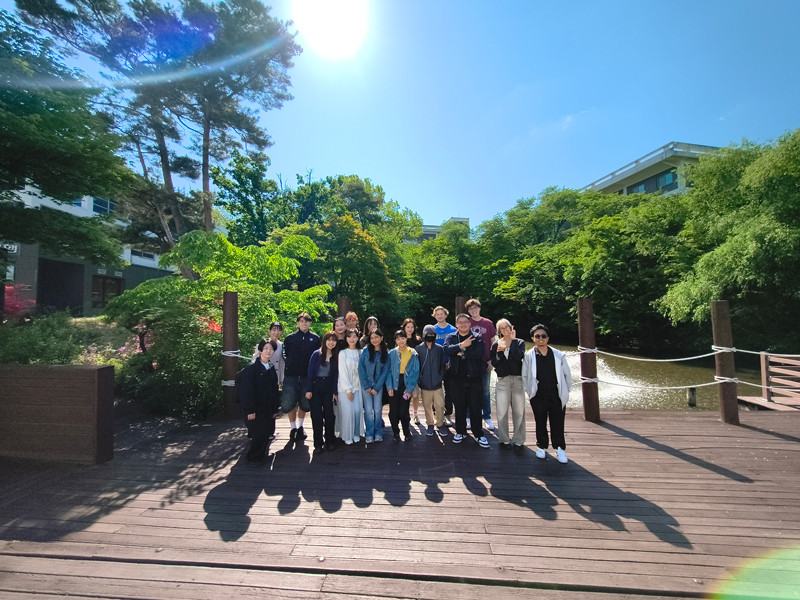
From Sunday, May 3 to Tuesday, May 5, 2026, a three-day study tour to Seoul, South Korea, was conducted as part of the Inter-University Exchange Project (US., etc.), “TUFS Training Program for Trans-Pacific Bridge Persons” (TP-Bridge).
TP-Bridge is an educational program in which students from Japan, the United States, and the Philippines work together to deepen international understanding. During this study tour, students expanded their learning through visits to museums related to Japan-Korea relations, lectures by faculty members at Seoul National University, and exchanges with Korean students. Rather than viewing Japan-Korea relations only as a bilateral issue, the tour encouraged students to consider history, memories of war, women’s human rights during wartime, and reconciliation from a broader perspective. Learning together with students from Japan, the United States, the Philippines, and Korea gave participants the opportunity to reflect on history through the lens of their own experiences and interests.
The study tour was led by the program coordinator and staff members. A total of 15 students participated: nine international students from partner universities and six Japanese students who will study at partner universities. The students stayed at on-campus accommodation at Seoul National University, sharing twin rooms.
Pre-tour Study
Before departure, participants attended orientation sessions and engaged in pre-tour study by watching lecture videos and reading related academic articles. Participants then prepared their own comments and questions, and took part in the study tour with their own sense of inquiry.
Day 1
On the first day, after arriving in Seoul, the group visited the Museum of Japanese Colonial History in Korea. Students viewed the Korean-language exhibits while using translation tools on their own. There were also moments when Japanese students explained parts of the exhibits to international students based on information they could understand from Japanese terms or Chinese characters. In this way, students supported one another and deepened their understanding together.
Day 2
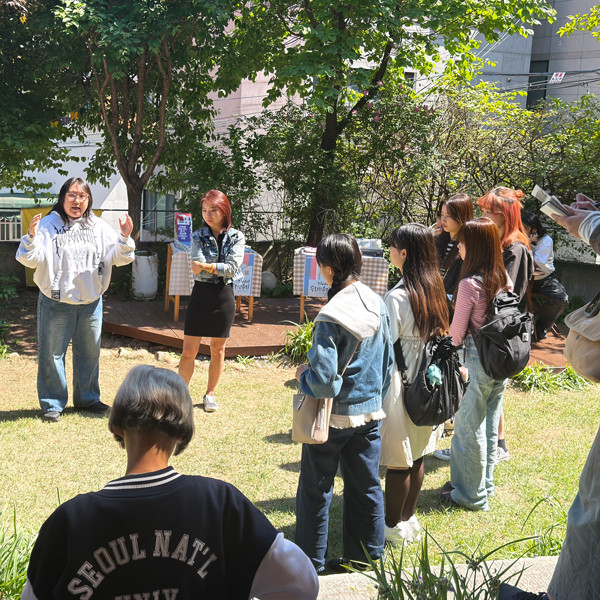
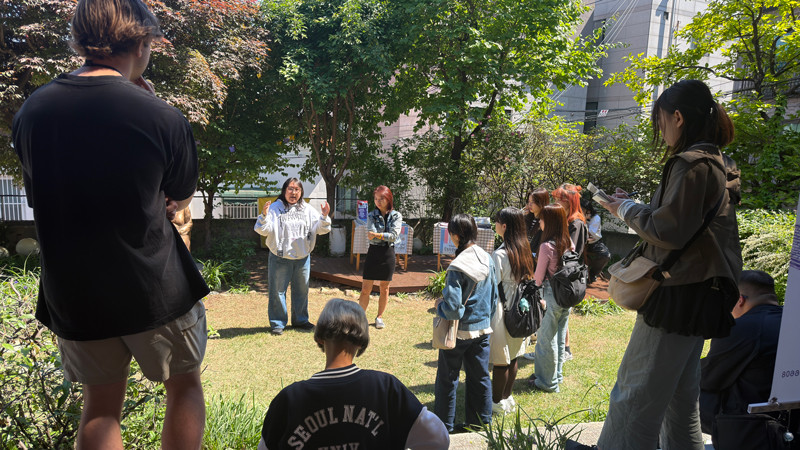
On the second day, the group visited Seoul National University (SNU). In the morning, students joined a campus tour led by a student volunteer from SNU.
After the campus tour, the students attended a lecture by Professor Ye Sul Oh of the Department of English Language and Literature at Seoul National University. In the lecture, students practiced close reading and engaged in group work using poems by Agha Shahid Ali, a poet with roots in Kashmir. Through this session, students reflected on the layered meanings of words, the diversity of interpretation, and the importance of reading carefully rather than quickly.
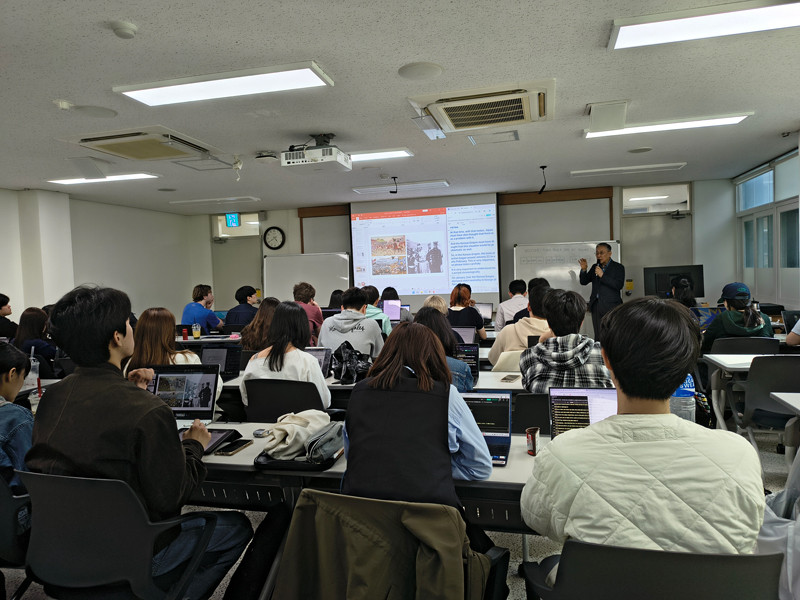
In the afternoon, students joined a class on reconciliation between Japan and Korea taught by Professor Ki-Jeong Nam of the Institute for Japanese Studies. The class was conducted in Korean, and students attended while using an AI interpretation system. Students from TUFS and SNU sat next to one another, allowing TUFS students to receive support from SNU students in understanding both the language and the content of the lecture.
After the class, an exchange session with SNU students was held. TUFS students and SNU students divided into small groups and talked about university life and their interests while sharing a meal. After the exchange session, some students from both universities also went out together, creating opportunities for interaction beyond the classroom.
Day 3
On the final day, the group visited the War and Women’s Human Rights Museum. Students learned while using audio guides. After the visit, a Q&A session with museum staff was held, during which students asked questions and shared comments about memories of war.
Student Reflections After the Tour
The reports submitted by students after the tour show that they did not approach history simply as knowledge, but connected what they learned to their own studies, future paths, and relationships with others. The following excerpts are taken from students’ individual reflections after the tour.
Realizing the importance of reading and thinking deeply
But now I see that history is not just a set of facts that you memorize and move on from. It is something that requires effort and attention if you actually want to understand the full picture. There are always perspectives that are left out or not emphasized enough and it is up to you to actually go and find them.
Learning through dialogue and diverse perspectives
Another thing I learned from the study tour was how important dialogue is, even when conversations become uncomfortable. There were moments where students had different opinions or emotional reactions to topics, but honestly I think hearing different perspectives was one of the most valuable parts of the experience.
Connecting the experience to understanding others and the future
It would be a great pity if personal relationships were damaged because of history or mutual ignorance. When I study abroad in the future, I hope to remain aware of what I do not know and to maintain an attitude of continuously learning about the cultures and backgrounds of others. (Originally written in Japanese)
-
This study tour was made possible again this year thanks to the cooperation and dedicated support of the professors and students of Seoul National University, as well as all those involved at each of the sites we visited. We would like to express our sincere gratitude to everyone who supported the students’ learning.
Reference
For inquiries about TP-Bridge
TP-Bridge Office, Inter-University Exchange Project (US., etc.)
tenkai-bridge-coordinator[at]tufs.ac.jp
Please replace [at] with @ when sending an email.