


TUFS Society for Sustainable Energy (”tafuene") x Faculty: Diverse Perspectives in Sustainability Research — Interviewing the faculties of JDPSR
研究室を訪ねてみよう!
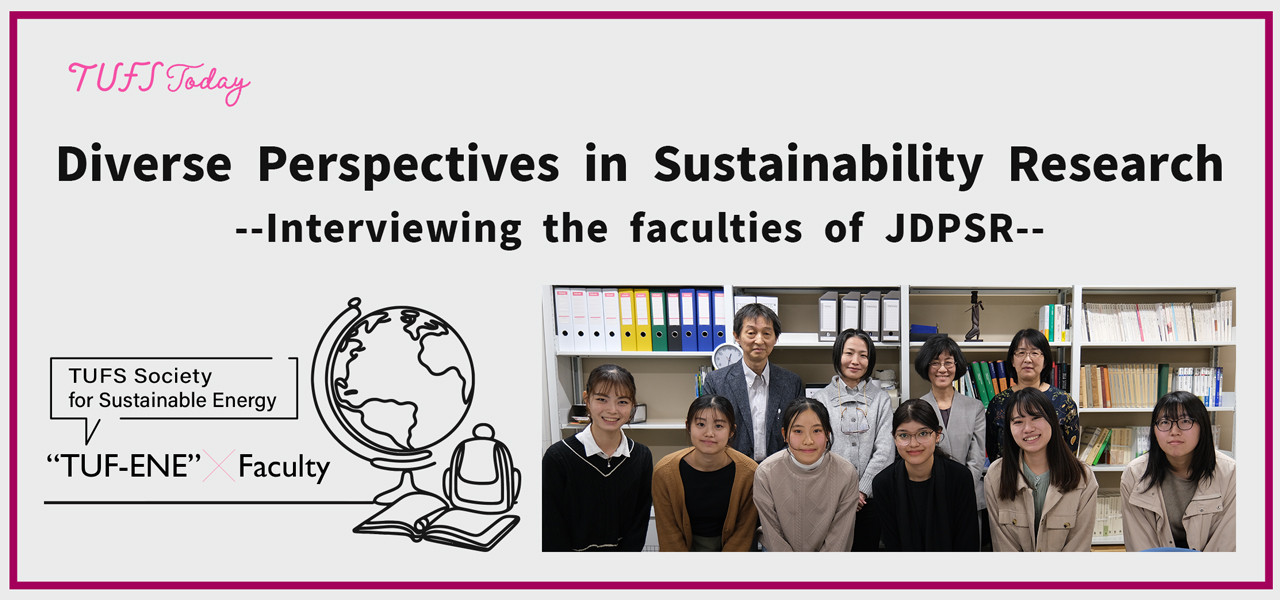
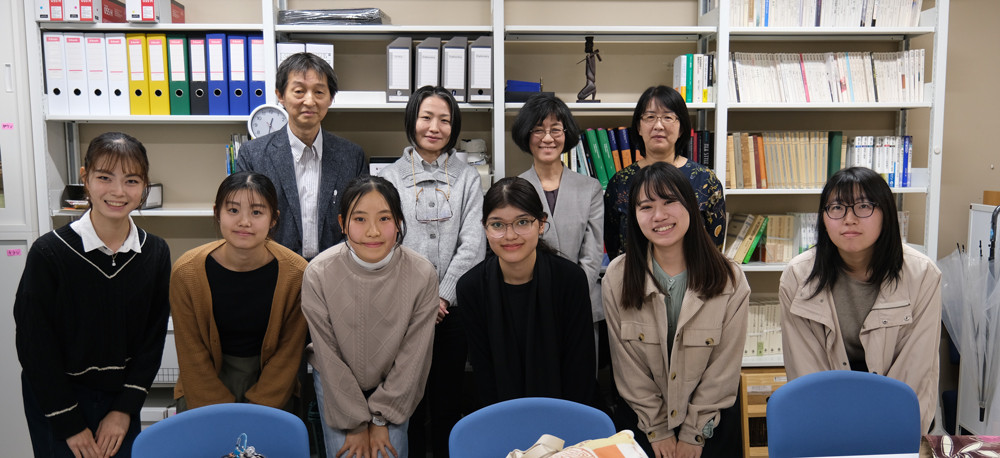
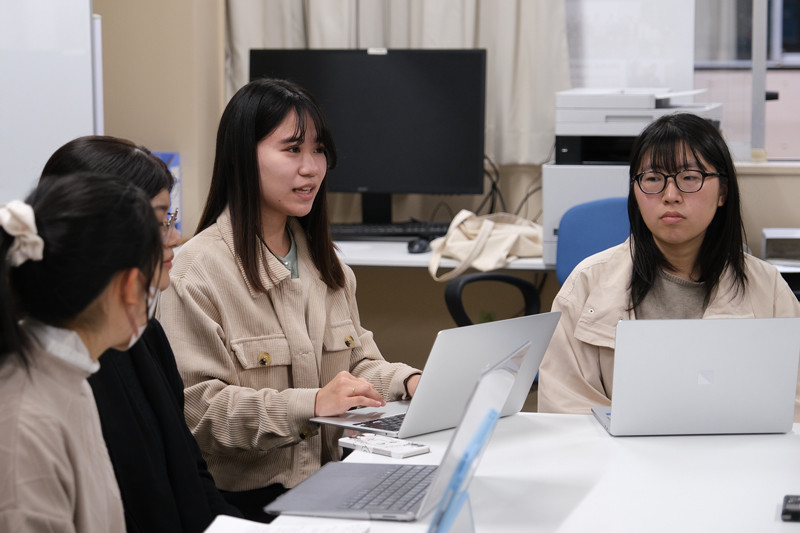
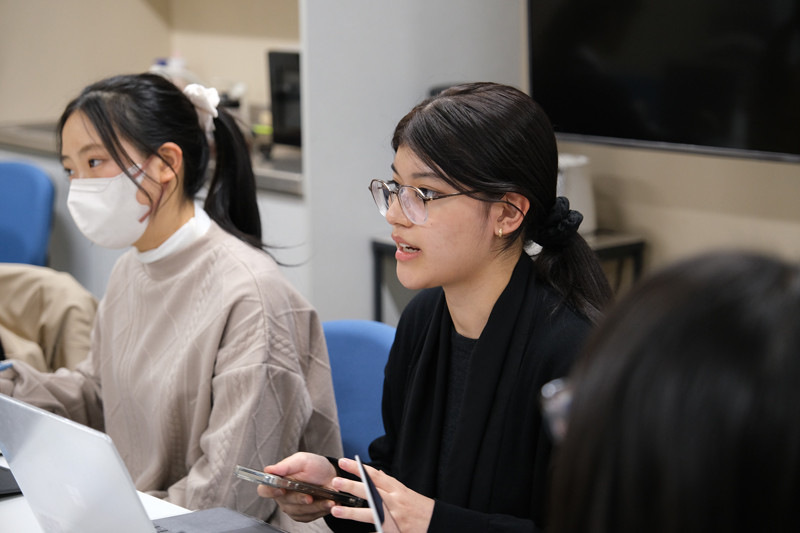
This is a series of interviews conducted by TUFS Society for Sustainable Energy (known as “tafuene”), the environmental student society at our university, with the aim of providing students with an opportunity to deepen their understanding of environmental issues in various regions of the world. For this specific project, we interviewed faculty members to provide a broad overview of the reality and prospects of the education and research undertaken by the Joint Doctoral Program for Sustainability Research (JDPSR) at the Graduate School of Tokyo University of Foreign Studies (TUFS). Professor Shinichi Takeuchi (Dean of the Program), along with Professor Chikako Nakayama, Professor Chizuko Sato, and Associate Professor Kazue Demachi, all involved in the program, discussed their definitions of sustainability, research approaches, and the distinctive characteristics of collaboration with the partner universities: Tokyo University of Agriculture and Technology (TUAT) and The University of Electro-Communications (UEC).
Interview Participants and Profiles
Professor Shinichi Takeuchi (hereafter, Takeuchi):
Teaches International Cooperation Studies in the School of International and Area Studies at the undergraduate level. He is specialised in African Studies, particularly in the study of political and conflict issues in the Central African region. Before joining TUFS in 2017, he spent approximately 30 years engaged in African Studies at the Institute of Developing Economies (IDE).
Professor Chikako Nakayama (hereafter, Nakayama):
Teaches Global Studies in the School of International and Area Studies at the undergraduate level. She has worked at TUFS since 2000. She is specialised in the history of economic thought and social thought. She offers lectures and academic supervision in the Joint Doctoral Program for Sustainability Research from a broader economic perspective, understanding it as the metabolic interaction between human society and nature.
Professor Chizuko Sato (hereafter, Sato):
Joined TUFS in April 2025. Before that, she worked at the Institute of Developing Economies (IDE), engaged in research on the politics and society of South Africa. She is specialised in African Area Studies, with a particular interest in land issues, migration, and refugee studies. At the undergraduate level, she teaches International Migration Studies in the first semester and History and Current Challenges of Refugee Protection in the second semester.
Associate Professor Kazue Demachi (hereafter, Demachi):
She specialises in macroeconomics. She teaches International Economics in the School of International and Area Studies. In the Joint Doctoral Program for Sustainability Research, she teaches Development Economics. She broadly supervises development-related fields, with a primary focus on empirical economic research.
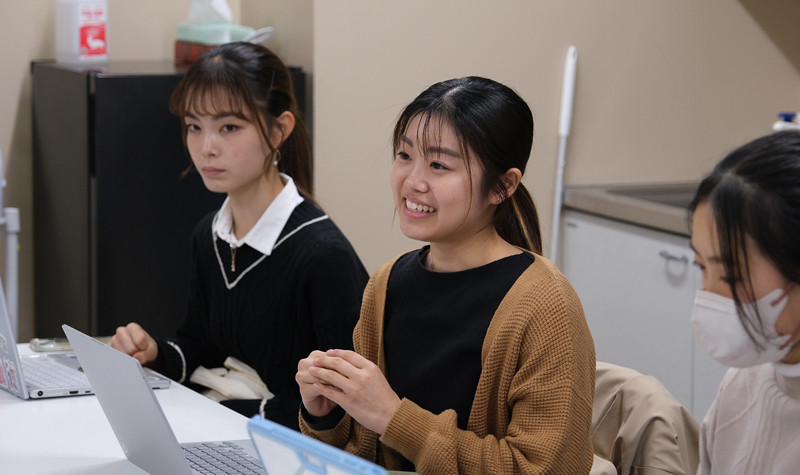
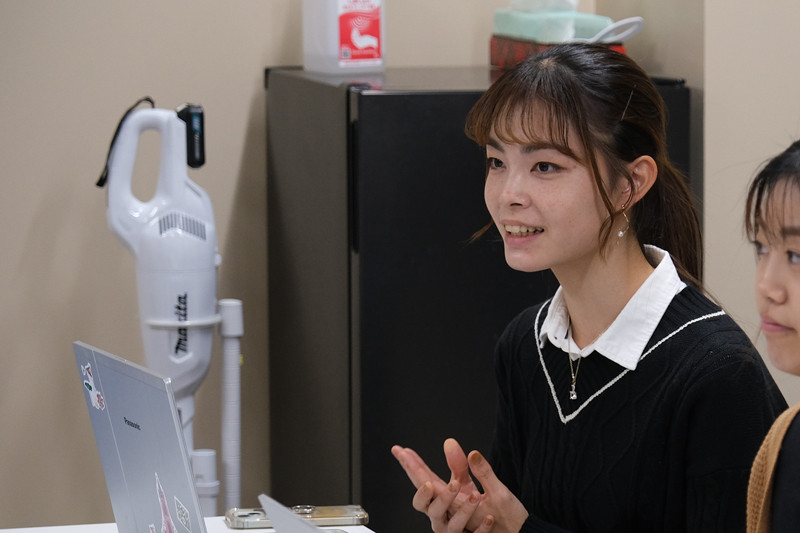
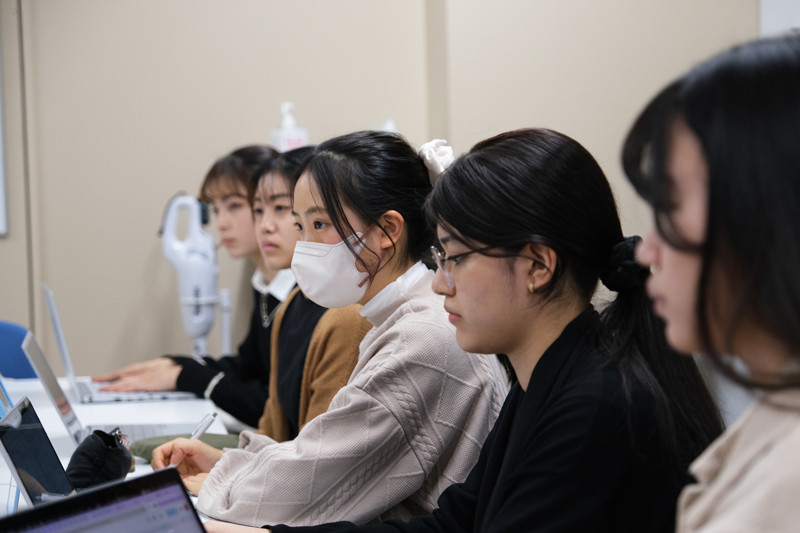
Interviewers: TUFS Society for Sustainable Energy (“tafuene” )
- Mayuko Suzuki (School of International and Area Studies, Central European Region/Polish, 3rd year)
- Shizuku Yoshinari (School of International and Area Studies, Oceania Region, 1st year)
- Aisha Mari Tanaka Butt (School of International and Area Studies, South Asian Region/Urdu, 2nd year)
- Ayumi Ryu (School of International and Area Studies, African Region, 2nd year)
- Noa Miyashita (School of International and Area Studies, Southeast Asian Region II/Thai, 2nd year)
- Mirei Suzuki (School of Language and Culture Studies, Southeast Asian Region II/Vietnamese, 2nd year)
──── How is “sustainability” defined within this “Joint Doctoral Program for Sustainability Research”?
Takeuchi: Sustainability research is different from the “SDGs.” The SDGs are merely politically determined goals set by the UN General Assembly. We believe that it is important for each student to deeply consider what sustainability truly means. Roughly speaking, it’s about how society, the economy, and the environment can progress without collapsing. In my case, my research relates to how to resolve conflicts, but students consider sustainability based on their individual themes. The broad framework involves the practical aspect of how society can continue without collapsing, and how to resolve problems when they arise.
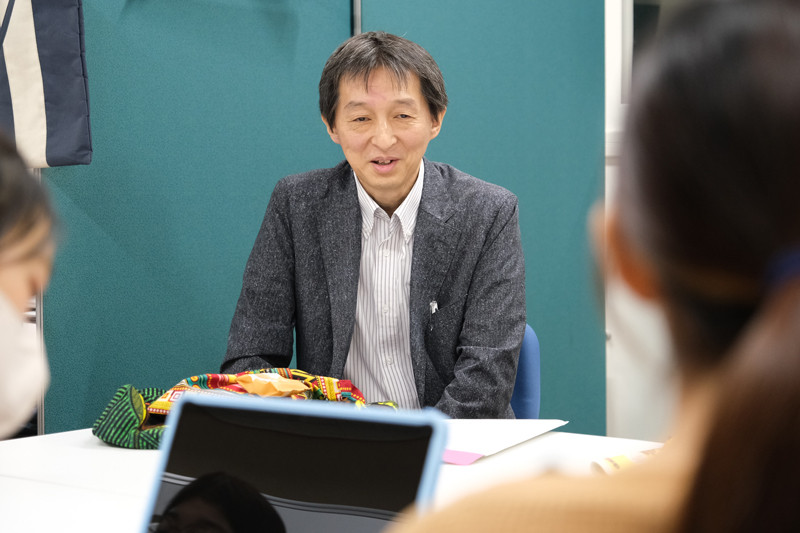
Demachi: I am specialised in Development Economics, so for me, “sustainability” has a relatively clear definition. The “classic” definition, such as that of the UN, states that sustainable development is whether economic development can coexist with the natural and global environment. I believe sustainability means devising ways to sustain the current economic progress while ensuring the sustainable use of common resources (such as water, soil, and forests) so that they are not degraded when future generations use them.
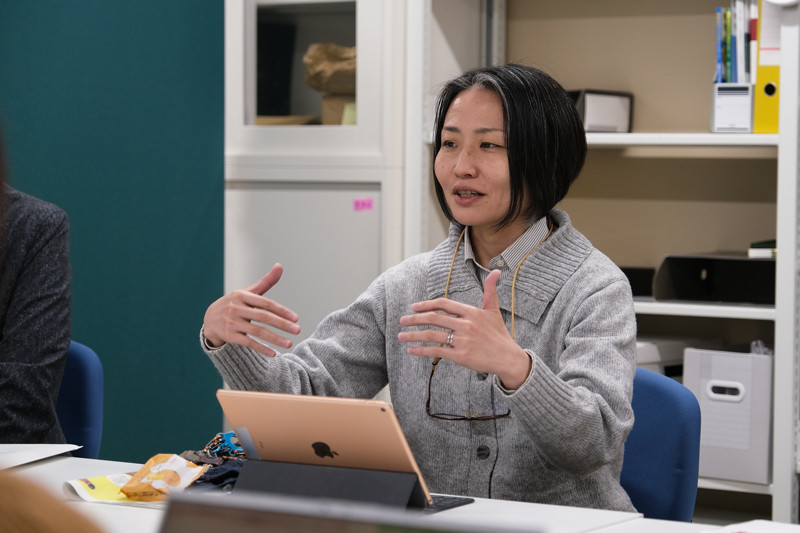
Nakayama: I study political economy, sharing some common ground with Assoc. Prof. Demachi, but my approach is from the perspective of theory and thought in that sense. Given the critical situation facing the current ecosystem, I am exploring whether the economy, in a broad sense, can be sustainable. Resources for human beings are provided as a result of natural accumulation over a long period, but human beings have utilised them in a way that depletes them quickly. Historically, human beings have had a profound impact on the natural environment, with effects that are often irreversible in the long term. I think sustainability means considering how to maintain a balance with nature for future generations and enabling human society to cope even in situations where nature is under stress. Furthermore, I think sustainability involves devising methods to adhere to the principle of “leaving no one behind,” particularly in the Global South, where the negative impacts are most serious.
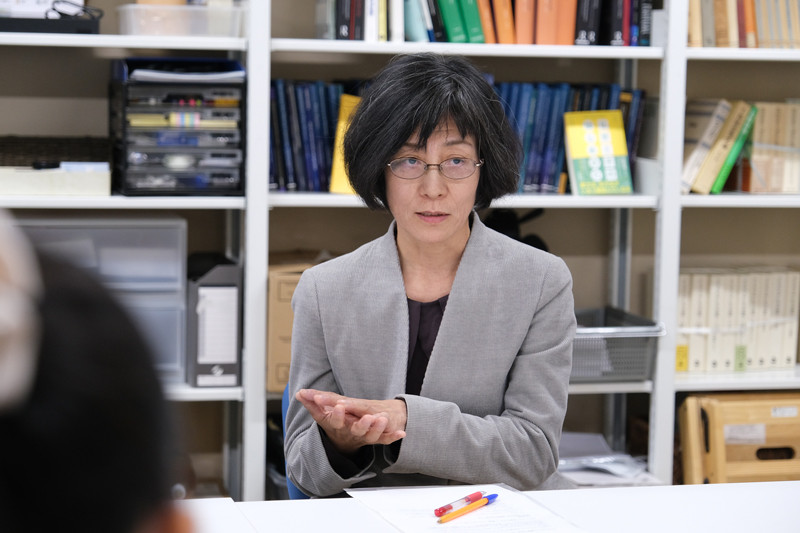
Sato: I also envision a future where society can continue without collapsing and the next generation can live safely. I am particularly interested in “relationships.” This encompasses the relationships between humans and other species, such as flora and fauna, as well as the interactions among diverse individuals within human society. I believe the core of sustainability lies in ensuring that these relationships do not break down and are maintained in a sustainable way.
──── In Japanese, the term “sustainability” is often translated as Jizoku Kano-sei (possibility of continuation). However, hearing your discussions, it sounds like it has a broader meaning, encompassing ideas like “to prevent collapsing” or “to keep it manageable.”
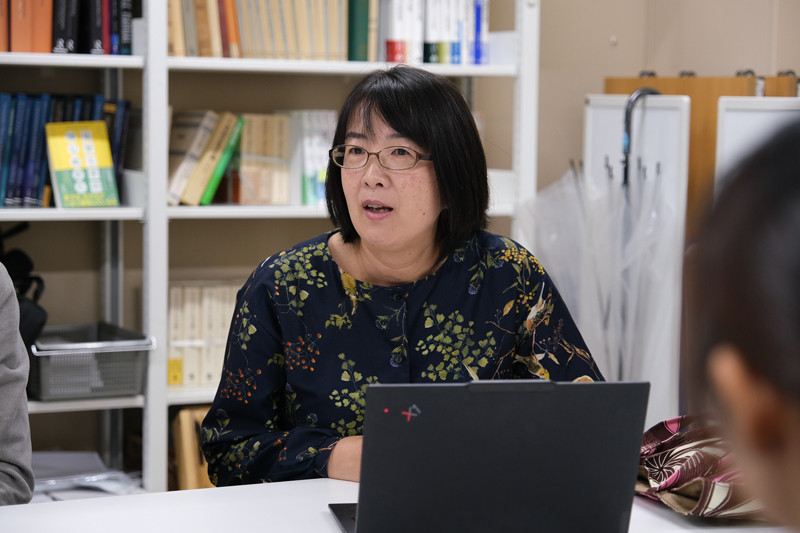
Nakayama: To add to that, some of the students with job careers I supervise in the graduate school are working for corporations. For private companies, “sustainability” often means the ability to consistently and reliably supply products and services. For example, bringing a production line back quickly after a machine breakdown is considered to be “sustainable,” with an emphasis on economic efficiency to maintain productivity and ensure business continuity. However, the sustainability of business and the protection of workers’ safety and health sometimes conflict. There are differences between the sustainability of business and the conceptual notion of sustainability that our academic research deals with. Everyone talks about the importance of “sustainability,” but when you look deeper, its meaning and priorities are full of contradictions, which makes it far from a simple topic.
──── What specifically do you emphasise in teaching sustainability?
Takeuchi: In the Doctoral Program, “teaching” is less about delivering knowledge in a lecture format and more about supporting thesis writing through individual supervision, where the faculty members also learn alongside the students on their chosen themes. I have supervised four doctoral dissertations so far, all on vastly different topics. The first student, from Iraq, dealt with food issues. The second, Japanese, tackled business and human rights issues in Africa, specifically Sierra Leone and Kenya. The third, Gabonese, focused on the role of extractive companies for community development in Gabon and Nigeria. The fourth student, from Namibia, studied the issue of teenage pregnancy among female students. Each student possesses specialised knowledge, and my main role is to check for logical consistency and ensure that the problem statement and the conclusion properly correspond. I truly feel that “teaching” in the doctoral program is also an act of “being taught.”
Demachi: When considering development and environmental issues, students and we ourselves tend to be easily drawn to straightforward topics like, for example, “electric vehicles are good” or “we should stop using fossil fuels.” However, what I consider important is the complex structure behind such matters. Manufacturing electric vehicles requires rare minerals, which are often mined in parts of Africa and Asia, leading to environmental pollution, human rights issues, and even conflicts. It is essential to question whether something is truly sustainable within the entire global system, rather than judging it as “sustainable” by looking at only one aspect. The student from Vietnam whom I am supervising is studying environmental issues in the Mekong Delta and the livelihoods of the riparian residents. Since the Mekong River flows through multiple countries, a fundamental understanding cannot be achieved by looking at only one region. I usually advise students to approach issues with a broad perspective.
Nakayama: I have supervised three Doctoral Program graduates so far; two Japanese and one Senegalese. The first Japanese student was interested in the sustainability of local communities and their living areas that were left behind after the closure of the coal mining industry, and pursued research on this topic. Fossil fuels are now considered to impose a high environmental burden, but the coal industry was once the centre of the economy. Based on that history, the student conducted interviews with elderly people in a small former mining town in Yamaguchi Prefecture and used a life-story analysis approach to trace the transformation of the community and its environment. The second Japanese student studied the Saku region of Nagano Prefecture, given its long tradition of progressive medical care and welfare initiatives. She examined who supports the sustainability of care welfare and how, in the face of depopulation and the acceptance of Technical Intern Trainees from abroad. Other student from Senegal focused on the livelihoods and economic structures of street vendors in the urban areas of the capital city, Dakar. He clarified through over 100 interviews that the informal economy supporting their lives is sustainable, although it operates outside the framework of the SDGs. In addition to thesis supervision, we also provide practical learning opportunities in the program. On one occasion, we conducted fieldwork walking along the Nogawa River, guided by an invited lecturer, a water issues expert, to investigate water quality and observe the surrounding flora and fauna.
Sato: I joined TUFS in this April and started supervising PhD students in the second semester. I am currently supervising three students, and all of their research topics are deeply related to sustainability. All of them are from African countries, Nigeria, Djibouti, and Mozambique. The student from Nigeria is studying oil-rich regions where local residents have not benefited from oil. She looks at the crude oil thefts and other sabotage activities against oil companies and pipelines, and investigates the background and meaning of these actions. The student from Djibouti is studying her country’s political system. While neighbouring Somalia has been experiencing conflict since 1991, Djibouti, with a similar ethnic composition, has remained stable. In exploring the reasons for this difference, she is asking whether Djibouti is a truly peaceful and sustainable country, or what we see is merely a surface stability maintained by the authoritarian government. The student from Mozambique is studying how women are contributing to food security. In each of their research projects, I instruct them to think deeply about how their topics are connected to the issue of sustainability and what they can say from a sustainability perspective.
──── The Joint Doctoral Program for Sustainability Research is a program conducted jointly with TUAT and UEC. How do you think TUFS can contribute to the concept of sustainability within the framework of the three universities?
Takeuchi: I feel that collaborating with The University of Electro-Communications (UEC) and Tokyo University of Agriculture and Technology (TUAT) to run this program has significant meaning. Each university has its own unique systems and areas of interest, and the relationship between faculty and students also differs significantly. For better or worse, TUFS tends to attract people with similar perspectives. However, by engaging with universities from different fields and cultures, I have reaffirmed the importance of TUFS’s unique perspective, way of thinking, and research stance. At TUFS, we are constantly required to view things from a broad perspective. We emphasise looking deeply into a specific region while simultaneously considering its meaning within a global context. I believe this understanding of context is the strength of the humanities and social sciences, especially at TUFS. In natural science and engineering universities, the depth of each specialised field tends to be prioritised, and contextual breadth is sometimes less emphasised. That is precisely why I feel TUFS’s contribution is very significant in fostering the ability to consider “what is being discussed and in what context.”
Demachi: Both TUAT and UEC are natural science/engineering universities, with many faculty members and students specialising in the fields related to environmental and other technologies. It is striking how differently they view and approach the exact same issue compared to us. When it comes to technology, perspectives such as how it will affect society or what its significance will be in the future sometimes seem less prioritised. However, recently, the necessity of paying attention to these social aspects has been increasing. We approach things primarily from a social context, and I believe that discussing with faculty and students with technical expertise allows us to complement our perspectives, leading to a deeper understanding. I believe the intersection of such different specialisations is very stimulating and meaningful.
Nakayama: In the field of natural sciences, the development of technology and the construction of theoretical models are progressing, but when applying it to real society, collaboration with experts in social sciences and humanities is required. The real application of technology involves the huge questions: “Where,” “For whom,” “What,” and “How” should it be introduced? For example, the meaning and impact of the same technology are completely different depending on whether it is introduced in a rural village in Africa or an urban area in Japan. Researchers in natural science understand the importance of such social contexts, but many are currently grappling with how to implement them effectively. On the other hand, it can be hard for researchers in the humanities and social sciences to imagine how technology enhances human life or how new technologies emerge. That is why, I believe, it is crucial to recognise our differences and cooperate while complementing each other. Furthermore, substantial funding is often required for the practical application of new technology, and such funding is typically allocated in line with specific directions or goals that may not directly lead to sustainability. Technologies that are viable as businesses on a scale where companies can expect good profit sometimes contradict the “sustainability within society” that TUFS faculty members emphasise. We conduct our research daily while confronting these challenges.
Sato: I have only been here for about six months and do not have enough experience to comment on the matter extensively, but I believe that what we can offer from the standpoint of the humanities and social sciences is the perspective of the meaning of technology for society. Society is not monolithic; it is composed of diverse people with varied positions and backgrounds. Therefore, I believe our important role is to ask questions like: “For whom and how is a particular technology useful?” and “What kind of impact will it have on society?”
──── It has been a valuable opportunity to learn again how significantly the understanding of sustainability differs based on one’s positions and specialised fields. We also gradually grasp your academic development, research perspectives, and the issues and viewpoints of students. We recognise that the education at TUFS plays a role in promoting international responses to sustainability while keeping a close eye on the shifts in global values and lifestyles. We believe that this is precisely the mission that TUFS and the Joint Doctoral Program for Sustainability Research should fulfil, and that we ourselves can deepen our understanding of sustainability from diverse perspectives, including environmental, social, and international relations. What we have learned today is a major takeaway for us. We hope that by disseminating this information to our fellow students, we can share and spread this knowledge with a wider audience. Thank you very much for your valuable time and insights today.