


[Graduates × Faculty ── Knowledge in Motion]
From Shizuoka to the World—Discussing Community Revitalization and the Future of Media:
A Roundtable Discussion with Przemek, President Haruna, Lecturer Fukuda, and International Student Adviser Ishida
世界にはばたく卒業生
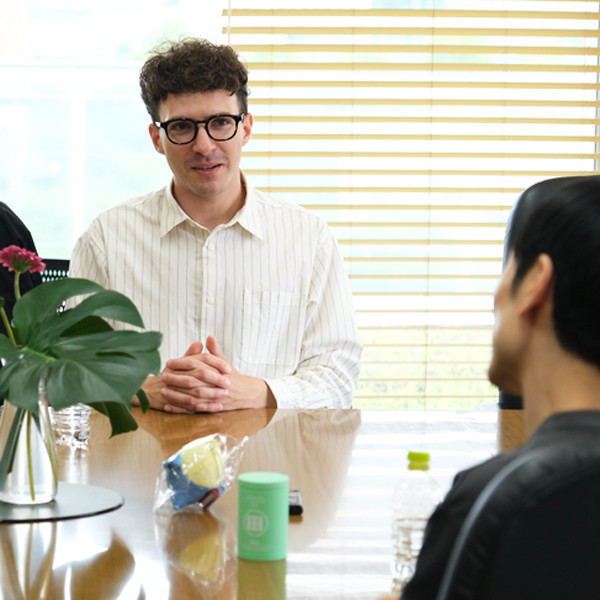

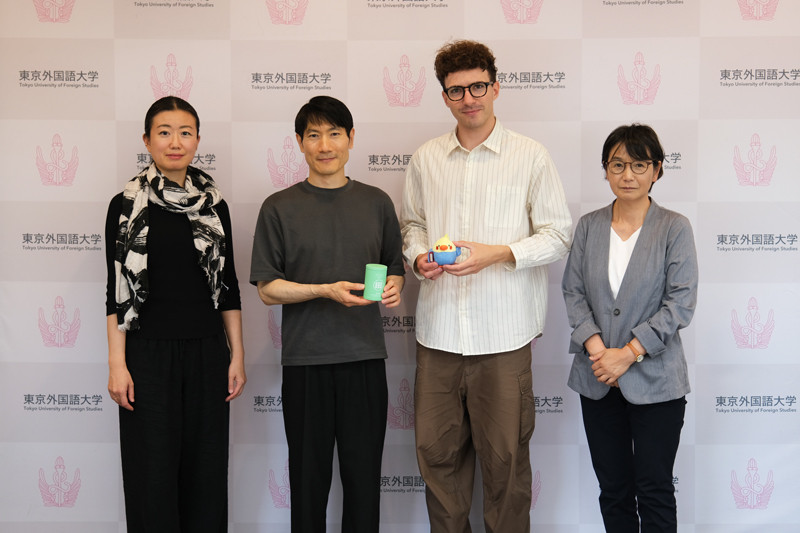
Przemek (Przemysław Herdzik), a native of Poland, graduated from the School of Japan Studies at Tokyo University of Foreign Studies in March 2025 and will take his first steps at a media company in Shizuoka starting in July. Through study tours to Fukushima and Yamagata during his time at the university, as well as his research on “social capital” in Tama New Town—which he began following Professor Haruna’s advice—he has encountered firsthand accounts from the field and gained many insights that challenged his preconceptions. Identifying with the saying that “people in the media are merchants of information,” he combines a “micro” perspective—attentive to the subtle sentiments of local communities—with a “macro” perspective that takes a bird’s-eye view of society. What strategy does he now have in mind to showcase Shizuoka to the world? Through a dialogue with President Haruna and others, we heard about community revitalization, the new roles the media should play, and Przemek’s passionate vision for the world.
出席者
-
Przemek (Przemysław Herdzik): From Poland. Graduated from TUFS in March 2025. Joined a media company in Shizuoka this July.
-
President Nobuo Haruna
-
Aya Fukuda, Specially Appointed Lecturer (Global Innovation Design Institute)
-
Rie Ishida, Special Researcher (International Student Advisor)
A Job That Discovers “Hidden Brilliance”
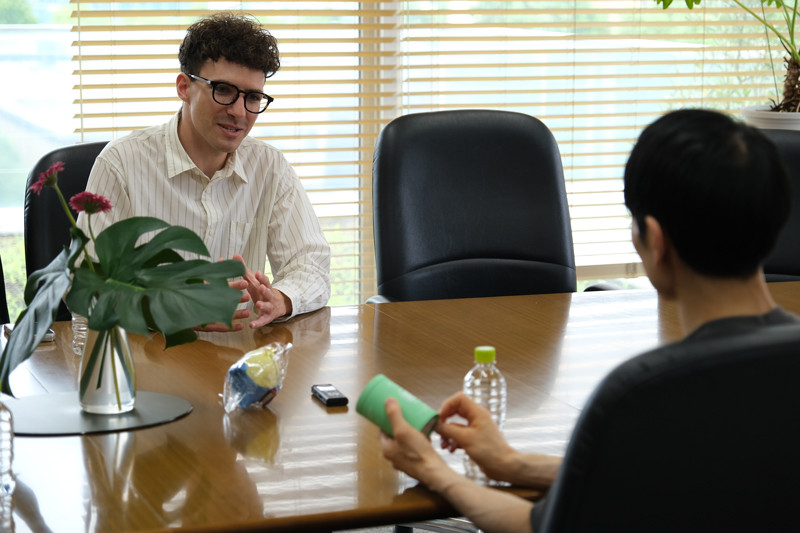
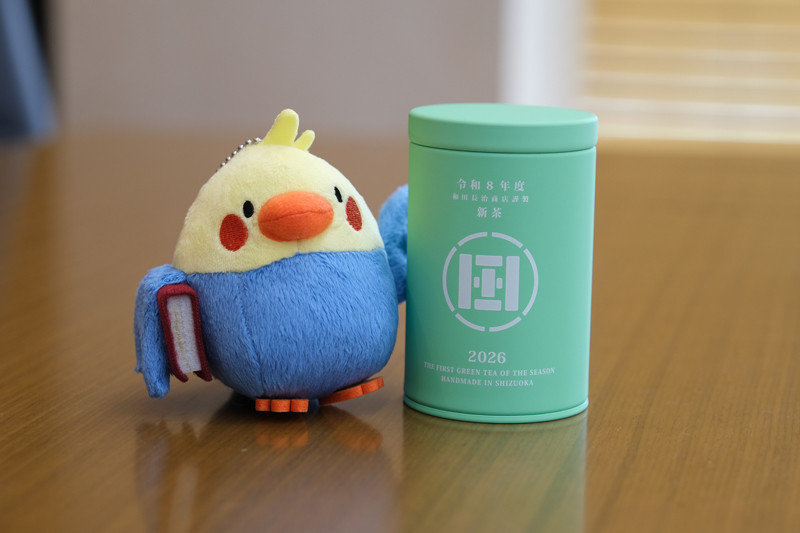
Haruna: Przemek, you’ve brought us a wonderful souvenir today. What makes this tea so special?
Przemek: Actually, this is from a long-established tea shop that purchased the tea that fetched the highest bid in this year’s first tea auction. I believe that finding these “unique local treasures” is both my job and my strength. Recently, a senior colleague at my company told me, “People in the media are merchants of information,” and I often find myself agreeing with that.
Haruna: You’re good at unearthing things that aren’t just the latest trends—things that aren’t widely known yet but still shine. That approach seems deeply connected to your experiences with the study tours in Yamagata and Fukushima that you focused on during your university days.
Preconceptions Dispelled in Fukushima and the Weight of “Firsthand Accounts”
Przemek: In fact, I highlighted my experience with the Fukushima study tour during my job interviews. I was very interested in the areas affected by the March 11 disaster, but before I went, I had the preconception that “the victims have nothing but criticism for nuclear power.” However, as I conducted repeated interviews with people from various backgrounds on the ground, that view changed significantly.
Fukuda: Przemek, you went around asking the same question—“Did your impression of nuclear power change before and after the nuclear accident?”—to everyone from fruit and vegetable farmer to Buddhist monk, an entrepreneur, and former Tokyo Electric Power Company employee, all of whom had different backgrounds.
Przemek: Yes. What surprised me most was when the farmer said, “Since this is a technology, we can’t improve it or make it safer unless we keep using it.” For me, who had assumed the response would be nothing but criticism, this was a very balanced perspective and came as a huge shock. I also heard stories about areas where evacuation orders were issued and areas where they weren’t—even though they were right next to each other—and how the presence or absence of compensation had given rise to feelings of “jealousy” among residents. These complex emotions and the real voices from the field are things I would never have understood unless I had actually gone there myself.
“Social Capital” Linking Poland and Tama New Town
Haruna: Your emphasis on valuing the “micro” voices from the field is also reflected in your graduation thesis, which examined “social capital” in Tama New Town.
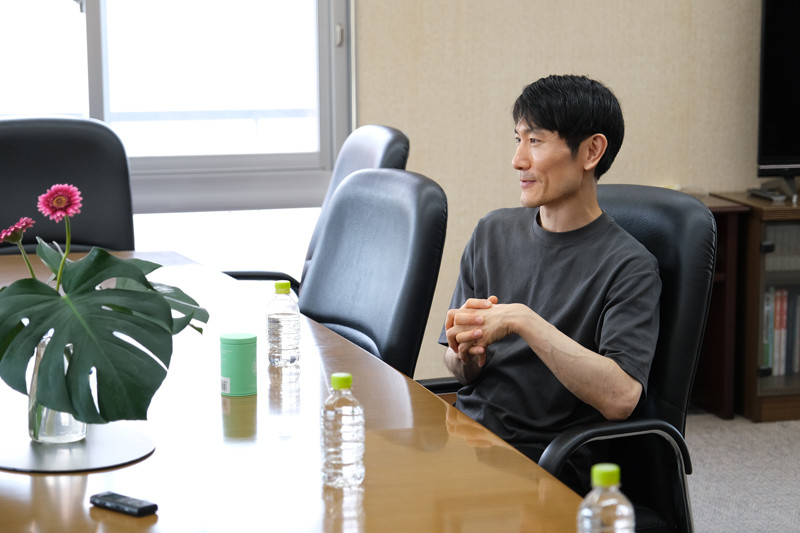
Przemek: It all started when I was a freshman and saw the “Kurumagaeshi Housing Complex” near the university; I was intrigued by how much it resembled the housing complexes built during the socialist era in my home country of Poland. Later, Professor Haruna suggested, “Why don’t you visit Tama New Town?” and my interest deepened even further after I went there as part of a class assignment. While volunteering at a community café in Tama New Town, I researched how “Mutually beneficial collective action” is maintained amid an aging population.
Haruna: Tama New Town, where the community seemed on the verge of collapsing due to an aging population, and Fukushima, which fell apart immediately after the crisis—were there any commonalities between them?
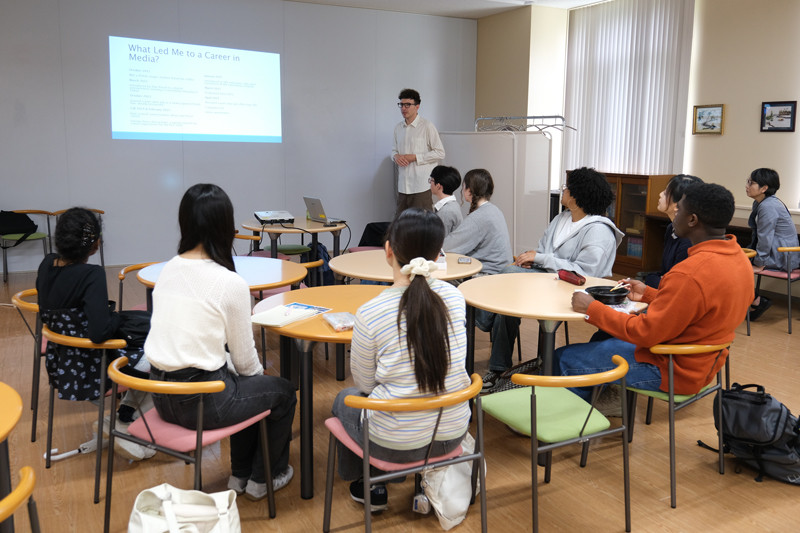
Przemek: Yes. There was a common question: “How should a community respond when faced with a crisis?” I consider the Tama New Town case to be a success story. These Japanese initiatives and lessons should be extremely beneficial for people overseas as well. In fact, during the Fukushima study tour, I had the opportunity to present our research findings in English to American students, which made me truly realize the significance of sharing Japan’s experiences with the world.
Challenges in Shizuoka: The Crisis in the Tea Industry and the Potential for Inbound Tourism
Ishida: Your life in Shizuoka will finally begin in July. What are your thoughts on Shizuoka’s tea industry? It seems that more and more households are no longer brewing tea in a teapot these days.
Przemek: I feel a sense of crisis regarding the news that Shizuoka’s tea production fell to second place, overtaken by Kagoshima the year before last. The shortage of successors is also a serious issue. As one solution, I believe there is great potential in attracting inbound tourists.
President Haruna: What specific approaches do you have in mind?
Przemek: We previously conducted an experiment to promote Shizuoka’s appeal in collaboration with a popular social media influencer. A reel video we posted introducing a tea farm where visitors can compare different teas on a terrace in the tea fields generated an incredible response from overseas. When it comes to reaching international audiences, social media—especially short-form reels and shorts—is overwhelmingly more effective than broadcast television.
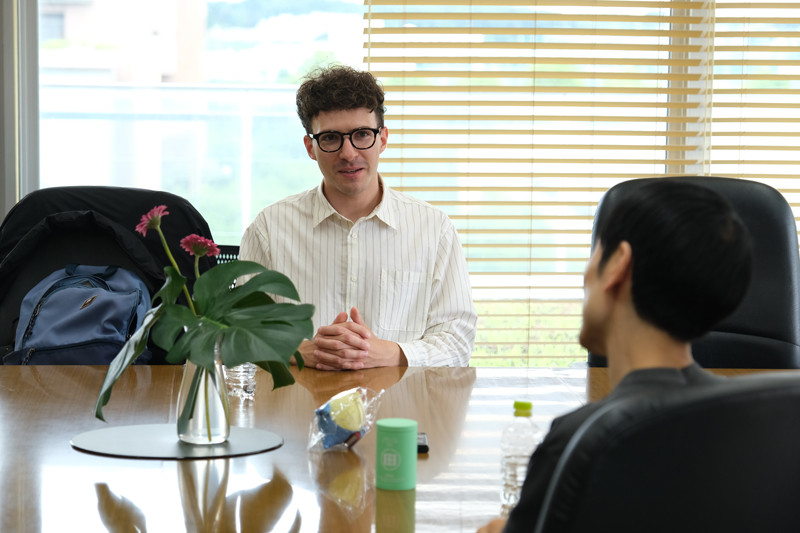
Fukuda: So short videos are more effective at reaching audiences these days, aren’t they?
Przemek: Yes. Unlike individual influencers, broadcast stations have advanced technology, equipment, and specialized expertise. By leveraging these resources, we should be able to create high-quality content. Many foreign tourists pass through Shizuoka on the Tokaido Shinkansen, and I feel that’s a real missed opportunity. I want to create content that makes them think, “Let’s hop off the train for a bit in Shizuoka.”
What I Learned at Tokyo University of Foreign Studies and the Confidence to Take on New Challenges
Ishida: Przemek, you mentioned that you “like taking on challenges,” didn’t you?
Przemek: To be honest, my first study tour was a very painful and embarrassing experience because I couldn’t express my thoughts well in Japanese. However, by not giving up and continuing to engage in conversation with Japanese people, I gained confidence not only in my Japanese language skills but also in Japan’s unique communication style.
Haruna: Your greatest strength, Przemek, is that you possess both a “micro” perspective—the ability to grasp the subtle sentiments of the local community—and a “macro” perspective—the ability to take a bird’s-eye view of society as a whole, such as Shizuoka’s location and tourism resources. Shizuoka is home to both Mount Fuji and tea, and it’s brimming with charms that should be shared with the world.
Przemek: Thank you very much. I will continue to deepen my learning from various sources—including the people of Shizuoka and tea experts—and strive to effectively convey Shizuoka’s wonderful culture to the world with even more specialized knowledge.
(Recorded on June 18, 2026)
References:
For inquiries regarding this article: : Public Relations and Collaboration Division, Public Relations Section, koho[at]tufs.ac.jp (Please replace [at] with @ when sending)