

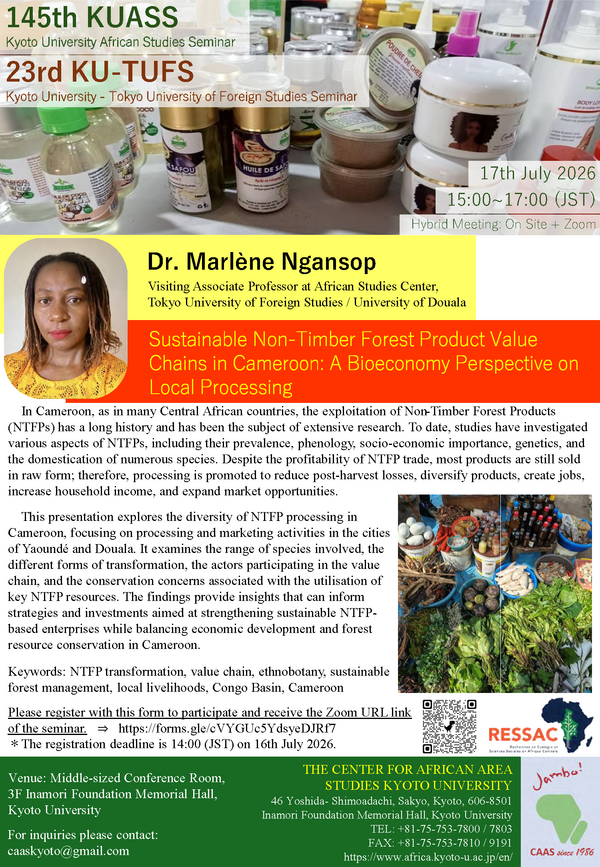
On Friday, July 17, 2026, 15:00~17:00
Dr. Marlène Ngansop, our visiting associate professor, will give a lecture at Kyoto University.
Title is "Sustainable Non-Timber Forest Product Value Chains in Cameroon: A Bioeconomy Perspective on Local Processing"
More Info:Center for African Area Studies, Kyoto UniversityUniversity of Kyoto
It will be organized as 145th KUAS (Kyoto University African Studies) Seminar and 23rd KU (Kyoto University)-TUFS (Tokyo University of Foreign Studies) Seminar.
◾️Date & Venue:17th July 2026(Friday)15:00~17:00
◾️Venue:Hybrid Meeting On Site
(Middle-sized Conference Room, 3F Inamori Foundation Memorial Hall, Kyoto University) + Online (Zoom)
◾️For attendance online, please register from below prior to the meeting.
Registration Form
*The registration deadline is 2pm on 16th July 2026.
◾️Language:English
◾️Abstract:
In Cameroon, as in many Central African countries, the exploitation of Non-Timber Forest Products (NTFPs) has a long history and has been the subject of extensive research. To date, studies have investigated various aspects of NTFPs, including their prevalence, phenology, socio-economic importance, genetics, and the domestication of numerous species. Despite the profitability of NTFP trade, most products are still sold in raw form; therefore, processing is promoted to reduce post-harvest losses, diversify products, create jobs, increase household income, and expand market opportunities.
This presentation explores the diversity of NTFP processing in Cameroon, focusing on processing and marketing activities in the cities of Yaoundé and Douala. It examines the range of species involved, the different forms of transformation, the actors participating in the value chain, and the conservation concerns associated with the utilisation of key NTFP resources. The findings provide insights that can inform strategies and investments aimed at strengthening sustainable NTFP-based enterprises while balancing economic development and forest resource conservation in Cameroon.
◾️Keywords:
NTFP transformation, value chain, ethnobotany, sustainable forest management, local livelihoods, Congo Basin, Cameroon
Report
The following pages contain reports on the seminar held at Kyoto University and on the visit to Kyoto and Shiga.
We kindly invite you to read them.
Japanese page:https://www.tufs.ac.jp/asc/activities/invited/Marlene-July17KU-TUFS.html
English page(The report of Dr.Marlene ):https://www.tufs.ac.jp/asc/english/activities/invited/Marlene-July17KU-TUFS.html