• DonationDonation
  • Access
  • Japanese
  • Tokyo University of Foreign Studies

Events

More
August 23, 2026

Summer Meetup 2026!(African Kids Club)

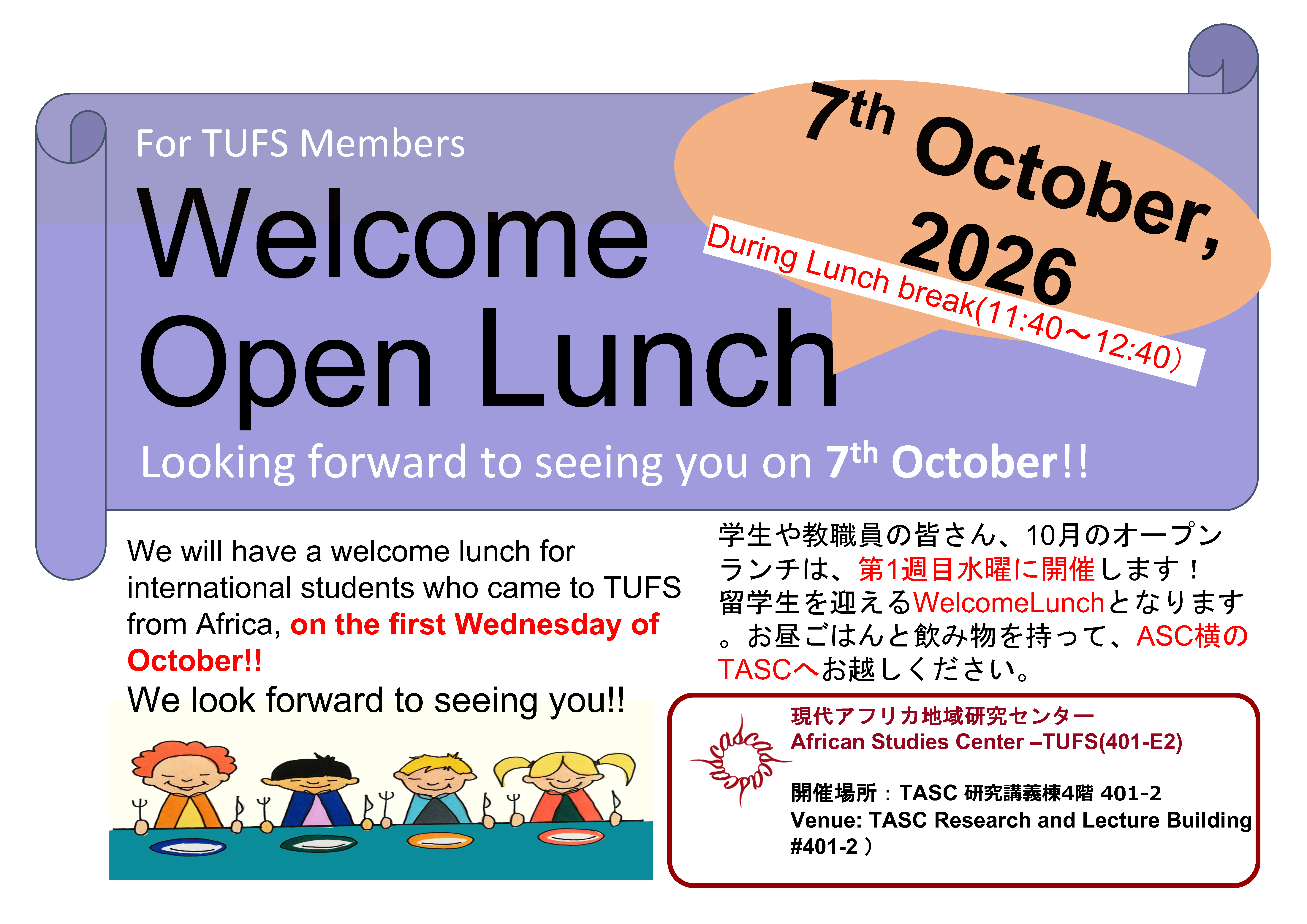
Summer Meetup: Family Exchange Event on August 23! This summer, We will co-host a special event with the African Kids Club (AKC), an initiative led by TUFS graduate students.On August 23, We will hold "Summer Meetup - Summer Holiday Exchange Event!" We warmly welcome parents and children to join us during the summer break. In collaboration with ASC-TUFS, this event is jointly organized with African international students and student volunteers. https://africankidsclub.ajf.gr.jp/20260823_akcevent_eng/ Part 1: Kids Exchange Program (14:00-17:00) Enjoy a variety of fun, hands-on activities where you can experience African cultures, including: Talks by African international students about their home countries, African games such as Mancala and target games Arts and crafts using colorful African fabrics accessory making A chance to taste dishes from three African countries For parents and guardians, there will also be opportunities to: Cook African dishes together with African mothers Join a hair care consultation session Spend quality time chatting, relaxing, and participating in activities with your children while connecting with others . Part 2: Youth (+ Adults) Exchange Program (17:30-20:00) The second part is designed for youth (and adults) and features: Presentations by African international students Self-introductions and group discussions Free networking time to share experiences and ideas A delicious African meal We warmly invite you to join us with your family and friends. We look forward to seeing you there! Date: Sunday, August 23, 2026 Time:◆Part 1 - Kids Exchange Program: 14:00-17:00◆Part 2 - Youth Exchange Program: 17:30-20:00 Participation Fee:・Adults / Youth: 1,000 yen・Children: 1,000 yen (500 yen from the third child onward) Registration Form: https://x.gd/qKiEP Capacity:◆Part 1: 60 participants◆Part 2: 60 participants (Please register early!) Venue: Okubo Community Center, 3rd Floor, Shinjuku Access ・8 min walk from JR Yamanote Line "Shin-Okubo" Station・13 min walk from JR Sobu Line "Okubo" Station・3 min walk from Tokyo Metro Fukutoshin Line "Higashi-Shinjuku" Station (Exit B3)・8 min walk from Toei Oedo Line "Higashi-Shinjuku" Station・3 min walk from Toei Bus "Okubo-dori" Stop Contact: africankidsclub@gmail.com Co-hosts: African Japan Forum (AJF) / African Kids Club (AKC) / African Studies Center (ASC)- Tokyo University of Foreign Studies Partners: African Kids Club Tokai / Chez Adama / Multicultural Exchange Club DANRO African Kids Club Links Website: https://africankidsclub.ajf.gr.jp/about_us/akc-2/ Facebook: https://www.facebook.com/African.Kids.Club/ Instagram: https://www.instagram.com/africankidsclub/ YouTube: https://www.youtube.com/@africankidsclub8102
Other Events
Summer Meetup 2026!(African Kids Club)
June 26, 2026

"LIMIT OF FOREIGN-LED ANTI-TERRORISM OPERATION AND THE RISE OF "SOVEREIGNTY" IN AFRICA"

Please register in advance using the QR code on the flyer. 【Flyer】June26TASC_IIR.pdf On Friday, June 26, a research seminar on jihadist organizations in the Sahel will be held at TASC on the 4th floor of the Research and Lecture Building at Tokyo University of Foreign Studies. The seminar will feature a presentation by Dr. Uesu, Research Fellow at Meiji University, and will be moderated by Prof. Hideaki Shinoda of the Institute of Global Studies, Tokyo University of Foreign Studies. The event is open to TUFS students and the public. We warmly invite anyone interested in the topic to join us. ◾️Title: "LIMIT OF FOREIGN-LED ANTI-TERRORISM OPERATION AND THE RISE OF "SOVEREIGNTY" IN AFRICA" ◾️Abstract: Ms. Uesu will discuss the rise of jihadist movements in Africa, with special reference to the Sahel region. She will also highlight the growing ideological emphasis on "sovereignty" among African countries, drawing on insights gained from her participation in the recent Dakar International Forum on Peace and Security, held in Senegal in April of this year. Ms. Uesu specializes in political economy and security issues in the Sahel and West Africa. She worked as a researcher at the National Graduate Institute for Policy Studies (GRIPS) and served as an advisor at the Embassy of Japan in France. ◆ Date & Time: Friday, June 26, 2026, 16:00-17:30◆ Venue: Room 401-2, 4th Floor, Research and Lecture Building, Tokyo University of Foreign Studies (TASC)◆ Format: In-person only◆ Open to the public◆ Language: English (*Questions and answers may be conducted in Japanese.) The deadline for registration is 12:00 noon on Wednesday, June 24.
Other Events
【研究会のお知らせ】LIMIT OF FOREIGN-LED ANTI-TERRORISM OPERATION AND THE RISE OF
June 10, 2026

The 114th ASC Seminar "Well-being and conservation concerns among indigenous peoples and local communities adjacent to conservation areas: the case of East Cameroon "

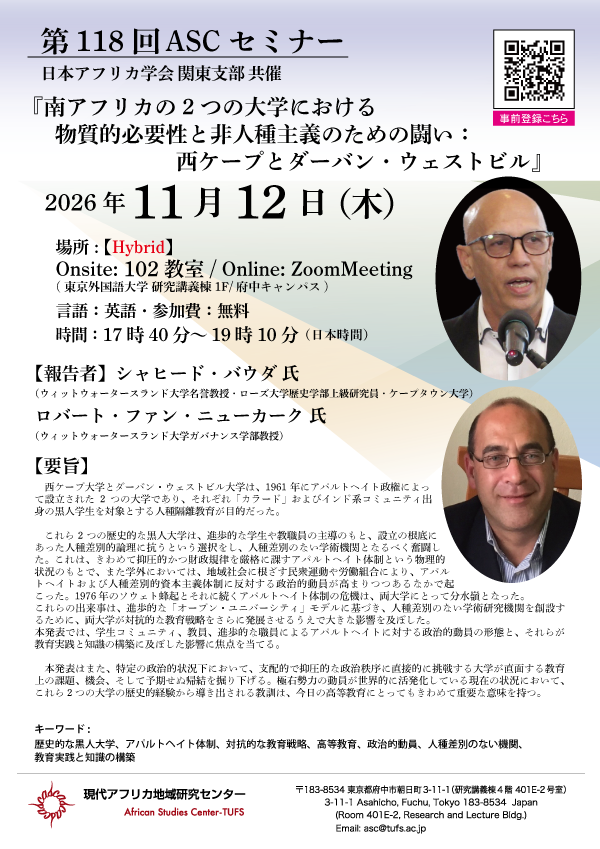
114_ASCSeminarEnglishVer.pdf The 114th ASC Seminar will feature a talk by Dr. Marlène NGANSOP on "Well-being and conservation concerns among indigenous peoples and local communities adjacent to conservation areas: the case of East Cameroon".The seminar will be held in a hybrid format, allowing participation via Zoom as well. Please be sure to register in advance. ※The schedule has been changed. June 3 → June 10 (updated on May 13). Title: "Well-being and conservation concerns among indigenous peoples and local communities adjacent to conservation areas: the case of East Cameroon"Abstract: Indigenous peoples and local communities (IPLC) living in conservation landscapes depend on Non-Timber Forest Products (NTFPs) for their well-being. However, restricted access to these resources within the conservation area often puts pressure on surrounding areas, raising conservation concerns. My research in the Dja Biosphere Reserve aims to understand how Indigenous Peoples and Local Communities rely on natural resources for their health and food security needs within a conservation context. This presentation illustrates these points by examining their living conditions, the contribution of NTFPs to their well-being, and the impact of conservation on resource availability in the surrounding areas. The final goal of the presentation is to provide an analytical framework for improving the living conditions of communities within conservation areas. Keywords: non-timber forest product, wellbeing, indigenous people and local communities, sustainable use, conservation concerns, Dja Biosphere Reserve ◆Speaker: Dr. Marlène NGANSOP (Visiting Associate Professor at African Studies Center, Tokyo University of Foreign Studies / University of Douala) ◆Date:Wednesday, June 10th, 2026/ 5:40p.m.~7:10p.m.(JST) 8:40a.m.~10:10a.m.(GMT)◆Venue:Hybrid・Onsite Room103(1F Research and lecture bldg.,TUFS Fuchu Campus)& Online(ZoomMeeting)・Access:https://www.tufs.ac.jp/abouttufs/contactus/access.html◆Language:English◆Addmission fee:FREE Just come straight to the classroom on the day of the seminar. You're welcome to join! Registration deadline: Noon June 10th, 2026 (Wed) ◆Jointly organized by African Studies Center - TUFS and Kanto Branch of Japan Association for African Studies Report The 114th ASC Seminar was held in a hybrid format and welcomed a total of 65 participants (17 in person and 48 online).Dr. Marlène, our invited Visiting Associate Professor, gave an in‑depth talk about her research, followed by a Q&A session.Even after the seminar, those who attended on-site continued an active discussion until later in the evening. We would like to express our sincere appreciation to everyone who participated.Please note that the deadline for submitting the participant questionnaire is June 17, one week after the seminar. We would be grateful for your cooperation.
ASC Seminars
第114回『保護区に隣接して暮らす先住民族および地域住民の福祉と保全上の懸念:カメルーン東部の事例から』
May 27, 2026

Notice of Cancellation of the 113th ASC Seminar

113_ASCSeminarEnglishVer.pdf The 113th ASC Seminar will feature a talk by Mr. MOUVY Dodzivi Eva Kekeli, Chargé d'Affaires, Head of Mission, Embassy of the Republic of Togo on "Togo, Mediator and Gateway of West Africa" The seminar will be held in a hybrid format, allowing participation via Zoom as well. Please be sure to register in advance. Title: "Togo, Mediator and Gateway of West Africa" Abstract: This presentation provides a comprehensive and detailed overview of Togo, exploring how this narrow, 600-kilometer-long West African nation leverages its strategic geographical positioning and historical neutrality to act as both a highly efficient economic gateway and a pivotal diplomatic mediator. Despite its relatively modest geographical size, Togo punches significantly above its weight on the African continent. A central focus of the presentation is Togo's exceptional logistical infrastructure, which capitalizes on its strategic location along the Gulf of Guinea. The Port of Lomé serves as the cornerstone of this strategy; as West Africa's only natural deep-water port, it presently handles over 30.6 million tonnes of cargo annually. It ranks as the region's premier container transit point and functions as an indispensable economic lifeline for landlocked Sahelian nations like Burkina Faso, Mali, and Niger. Furthermore, the Gnassingbé Eyadéma International Airport reinforces this connectivity by acting as a major aviation hub for ASKY Airlines, accommodating over 1.5 million passengers yearly. Economically, Togo demonstrates a resilient growth rate of approximately 5.3 percent and is actively transitioning from a transit-based economy to an industrialized model through initiatives like the Adétikopé Industrial Platform. This structural transformation is heavily supported by a dynamic population of 8.8 million people and substantial human capital investments driven by public institutions such as the University of Lomé and the University of Kara. Politically, the country maintains security and stability, having shifted to a parliamentary system in May 2024 to establish a new model of institutional governance. Beyond trade, the presentation thoroughly emphasizes Togo's robust soft power strategy as the highly respected "Swiss of Africa". Rooted in a strict policy of non-interference, Lomé has historically brokered significant peace agreements, including the 1999 Lomé Peace Accord for Sierra Leone. Today, President Faure Gnassingbé effectively continues this celebrated legacy of quiet diplomacy. In the volatile Sahel region, Togo has kept dialogue and maritime ports open for transition governments, most notably securing the 2023 release of 46 Ivorian soldiers detained in Mali. Furthermore, Togo actively mediates the complex conflict between the Democratic Republic of Congo and Rwanda by championing a strategic "Framework of Coherence". This framework gracefully aligns overlapping regional peace initiatives, such as the Luanda and Nairobi processes, to ensure unified diplomatic action. Ultimately, Togo's national success is securely built upon a dual-pillar strategy balancing cutting-edge physical logistics with impartial diplomacy. By seamlessly connecting both goods and people across borders, Togo definitively proves itself to be an indispensable anchor for continental peace, economic resilience, and sustained regional integration. Keywords: Logistics Hub, Deep-Water Port of Lomé, Regional Mediator, Strategic Neutrality, West Africa Gateway, Transshipment, ECOWAS, Adétikopé Industrial Platform (PIA), Sahel Stability, Great Lakes ◆Speaker: Mr. D. E. Kekeli MOUVY, Chargé d'Affaires, Head of Mission, Embassy of the Republic of Togo Bio-note: Dodzivi Eva Kekeli Mouvy is a Togolese diplomat with over fifteen years of experience in international relations, public administration, and diplomatic protocol. After serving at the Ministry of Foreign Affairs, he worked at the Prime Minister's Office as Chief of Protocol from 2014 to 2020, coordinating high-level state ceremonies. Since 2020, he has been posted to Japan. Currently serving as Chargé d'Affaires a.i., he heads the Embassy of the Republic of Togo, overseeing bilateral relations with Japan and outreach across the Asia-Pacific. His responsibilities encompass political and economic diplomacy, investment promotion, and multilateral engagement. Alongside his diplomatic duties, he is pursuing a Doctorate in Business Administration (DBA) at the International University of Leadership in Florida. His research focuses on how multilateral partnership platforms generate concrete development outcomes for Africa, aiming to strengthen strategic diplomacy that links international cooperation with national priorities. ◆Date:Wednesday, May 27th, 2026/ 5:40p.m.~7:10p.m.(JST) 8:40a.m.~10:10a.m.(GMT)◆Venue:Hybrid・Onsite Room 103(1F Research and lecture bldg.,TUFS Fuchu Campus)& Online(ZoomMeeting)・Access:https://www.tufs.ac.jp/abouttufs/contactus/access.html◆Language:English (No taranslate)◆Addmission fee:FREEPlease pre-register in advence from here. Or Use QR Code.※ The Zoom link will be sent after you pre-registerd. Registration deadline: Noon May 27th, 2026 (WED) ◆Jointly organized by African Studies Center - TUFS and Kanto Branch of Japan Association for African Studies Notice of Cancellation of the 113th ASC Seminar We regret to announce that the 113th ASC Seminar, scheduled for May 27, has been cancelled due to unforeseen circumstances affecting the speaker, the Chargé d'Affaires ad interim of the Republic of Togo. We sincerely apologize for this last-minute cancellation and for any inconvenience caused to those who had registered for and planned to attend the seminar. At present, there are no plans to reschedule this event. Should a similar event be organized in the future, we will provide further information through our website and other communication channels. We greatly appreciate your understanding and apologize once again for any disappointment or inconvenience this cancellation may cause.
ASC Seminars
【第113回ASCセミナー中止のお知らせ】

Visit to the National Museum of Nature and Science

August 1, 2026
Visit to the National Museum of Nature and Science, Tokyo-Ueno On the August 1 st, I visited the National Museum of Nature and Science in Ueno with Pr. Takanori Oishi. The museum is remarkably large, offering extensive exhibition spaces that cover various fields, including Japanese culture, natural history, biodiversity, geology, and scientific research. The organization of the museum allows visitors to explore the relationships between humans, nature, and scientific discoveries through different thematic exhibitions. Exhibitions on Japanese Culture and Human History A dedicated section of the museum presents the results of research activities conducted by the Research Institute for Humanity and Nature (RIHN), highlighting its interdisciplinary approach that integrates natural sciences, social sciences, and humanities to address global environmental challenges. Through collaborative research on biodiversity conservation, sustainable resource management, and human nature relationships, RIHN demonstrates the importance of combining scientific knowledge with social and cultural perspectives. This exhibition reinforced the idea that effective biodiversity conservation requires a comprehensive understanding of both ecosystems and the societies that depend on them. One section of the museum is dedicated to Japanese culture and human experiences, presenting objects, models, and research projects that illustrate daily life, cultural practices, and the evolution of human societies. The museum also showcases various research activities, including projects conducted in collaboration with the institution, highlighting the contribution of scientific research to understanding human history and interactions with the environment. Flora, Fauna, and Natural History Collections I also explored several floors presenting the flora and fauna of Japan and other regions of the world. The museum houses an impressive diversity of biological collections, including plant specimens, minerals, zoological collections and human evolution. This structure facilitates learning and encourages visitors to develop a deeper understanding of biodiversity and scientific discovery. Visitors can observe both taxidermy specimens and realistic representations of animals in their natural environments, providing a better understanding of species diversity, ecology, and evolutionary history. One of the highlights of my visit was the opportunity to take a photograph with the "Lucy" specimen, a highly realistic replica of the famous Australopithecus afarensis fossil. This representation provides an impressive visualization of human evolution and allows visitors to better appreciate the history of our species. Scientific Approach and Educational Value What distinguishes the Ueno National Museum of Nature and Science is the strong scientific approach underlying the entire collection. The information panels accompanying each specimen go beyond simple identification; they provide details on species ecology, behavior, biological characteristics, evolutionary history, and their significance within natural systems. This approach reflects the mission of a modern natural history museum, where collections serve not only for display but also for education, research, and knowledge transmission. Educational Importance & Reflection for the Millennium Ecologic Museum (MEM) A visit to the Ueno National Museum of Nature and Science represents a valuable learning opportunity, particularly for students and young people interested in science, biology, ecology, and research careers. As a curator at the Millennium Ecologic Museum (MEM), the first natural history museum in Central Africa, this visit was particularly inspiring. Located in Yaoundé, Cameroon, the museum is a scientific institution whose vision and mission are to conserve the biodiversity of Cameroon and the Congo Basin for present and future generations. Located in a natural site, MEM has developed the innovative concept of an eco-museum-laboratory, bringing together living biodiversity, scientific collections, researchers, and the public in a single location. Its activities encompass biodiversity conservation, scientific research, environmental education, scientific ecotourism, and the promotion of sustainable natural resource management. This experience provided me with valuable insights into the organization and development of museum exhibitions, particularly the thematic structuring and presentation of collections to make scientific knowledge more accessible, engaging, and relevant to diverse audiences. Together with Pr. Takanori Oishi, we discussed the possibility of developing similar exhibitions at MEM through collaborations with government ministries, universities, research institutions, and embassies in Cameroon. Such initiatives could strengthen scientific communication, promote biodiversity awareness, and further enhance the role of MEM as a platform for education, research, scientific ecotourism, and cultural exchange. Report and photographs by Dr. Marlène NGANSOP.
Activities
国立科学博物館を訪れました

Visit to Jindaiji Buddhist Temple, Tokyo-Chofu

July 31, 2026
Visit to Jindaiji Buddhist Temple, Tokyo-Chofu On 31 July, I visited Jindaiji Temple, one of Japan's oldest and most renowned Buddhist temples. Located in Chofu, Tokyo. Dedicated to the Buddhist deity Jindai Daishi. It is particularly known for prayers related to good fortune, protection, and harmonious relationships. The weather was pleasant, making the visit particularly enjoyable. Beyond its architectural beauty and tranquil atmosphere, what impressed me most was the strong attachment of the Japanese people to their cultural and spiritual heritage. The temple complex also includes a cemetery dedicated to companion animals (pets), something I had never encountered before. It was my first time seeing a cemetery where dogs, cats, and other beloved pets are memorialized. I observed several visitors praying and paying their respects at these graves, illustrating the deep emotional bond between people and their animals and the respect accorded to them even after death. Throughout the visit, I observed worshippers participating in religious ceremonies, offering prayers, and making offerings at different shrines. Many visitors purchased or carried omamori (protective amulets), which are believed to bring good fortune, health, success, and protection from misfortune. Witnessing these daily religious practices highlighted how traditional beliefs continue to occupy an important place in modern Japanese society. The visit also provided a deeper understanding of the Japanese perception of the relationship between humans, animals, spirituality, and nature, where respect and remembrance extend beyond human life alone. I observe that, beyond its spiritual importance, Jindaiji Temple is also a vibrant cultural and social destination that attracts both local and international visitors. During my visit, I had a long and enriching conversation with some Japanese visitors, who were interested in learning about my stay in Japan, my research activities, and the significance of this international experience for my academic and personal development. This exchange made the visit even more memorable, demonstrating that the temple serves not only as a place of worship but also as a space where people from different backgrounds can meet, share experiences, and foster mutual understanding. Visit to Jindai Botanical Garden, Tokyo-Chofu On the same day, 31 July, I also visited the Jindai Botanical Garden in Chofu, Tokyo. Established in 1961, the garden covers approximately 49 hectares and hosts a remarkable diversity of plant collections, including more than 100,000 plants and cultivars. The garden is organized into several thematic areas, including the Rose Garden, Azalea Garden, Camellia Garden, Plum and Cherry Tree Collections, Aquatic Plant Area, Greenhouse, and sections dedicated to Japanese and Chinese peony tree species, among others. One particularly interesting section was dedicated to Japan's pioneer tree species, which naturally colonize disturbed environments following natural or human-induced disturbances. These species play a crucial ecological role by stabilizing soils, improving environmental conditions, and facilitating the establishment of later successional forest communities. Among the representative tree species observed were Quercus salicina (Japanese evergreen oak), Quercus variabilis (Chinese cork oak), Fagus crenata (Japanese beech), Carpinus japonica (Japanese hornbeam), Fraxinus sieboldiana (Japanese flowering ash), Koelreuteria bipinnata (Chinese flame tree), Cornus macrophylla (large-leaved dogwood), Celtis sinensis (Chinese hackberry), Styrax japonicus (Japanese snowbell), Neolitsea sericea (Japanese silver tree), Pinus densiflora (Japanese red pine), and Zelkova serrata (Japanese zelkova), all of which are characteristic components of Japan's temperate forests. The tour continued through the famous Rose Garden, which showcased an extraordinary variety of roses in a wide range of colours, shapes, and fragrances. Among the cultivars I identified were "Lilibet, Redcap, Fragrance, Annabelle, Queen of Jindai, Princess Chichibu, Peace, and Papa Meilland". I was fascinated by the distinctive names given to many of these roses, several of which are inspired by women's names or iconic female figures. I also explored the large greenhouse, where many flowering plants were in full bloom. The begonias were particularly striking, displaying countless shades of pink, red, white, orange and salmon. The richness and intensity of their colours made for a striking spectacle and illustrated the remarkable ornamental diversity achieved through horticultural selection. I also visited the section dedicated to tropical forest understorey plants, which featured a rich collection of ornamental species characterised by the diversity of their foliage, textures and growth habits. This section also fuelled my reflections on the Cameroon Embassy's participation in the Green Expo 2027, particularly with regard to showcasing Cameroon's exceptional tropical biodiversity and its various ecosystems. Another memorable experience was observing the collection of carnivorous plants, including species of Venus flytrap (Dionaea muscipula), pitcher plants (Nepenthes spp.), and sundews (Drosera spp.). Seeing these fascinating plants in their natural form was especially interesting because they are often portrayed in cartoons and movies as dangerous "man-eating" plants. In reality, they are highly specialized species that have evolved ingenious mechanisms to trap small insects, enabling them to obtain nutrients in nutrient-poor environments. Overall, the visit to Jindai Botanical Garden offered valuable insights into Japan's botanical richness, ranging from native forest ecology and ecological succession to ornamental horticulture and unique plant adaptations. The diversity of collections reflects Japan's strong commitment to biodiversity conservation, environmental education, and the preservation of its botanical heritage. The botanical garden is exceptionally large and remarkably well organized, with clearly identified thematic sections that make it easy for visitors to explore its diverse collections. Unfortunately, the intense summer heat and strong sunshine limited the duration of my visit, preventing me from exploring every section of the garden. Report and photographs by Dr. Marlène NGANSOP.
Activities
調布市の深大寺を訪問しました

Visit to the Embassy of the Republic of Cameroon in Japan

July 27, 2026
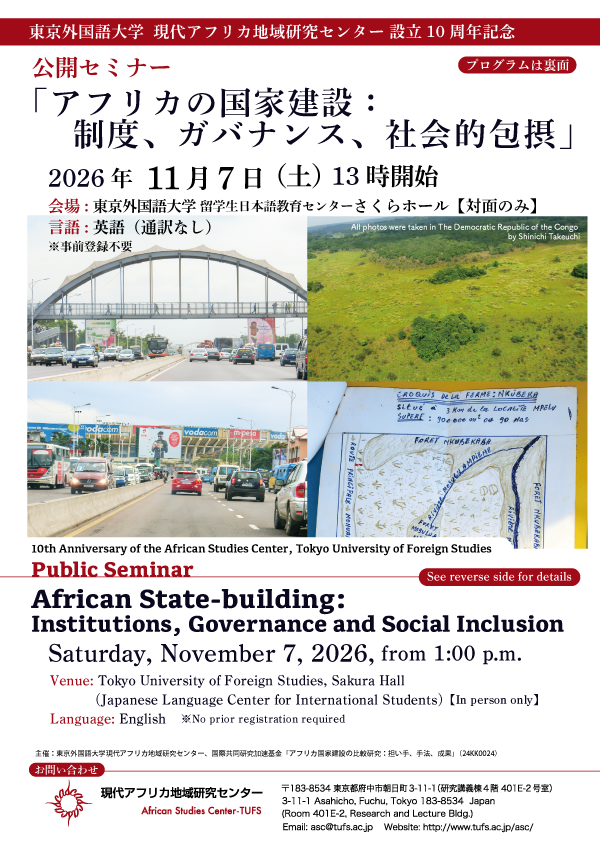
Our visiting associate proffessor. Marlène visited the Ambassador of Cameroon on July 27 and had a pleasant conversation. She kindly wrote a report about the meeting, so please take a moment to read it. Visit to the Embassy of the Republic of Cameroon in Japan On Monday 27 July, I had the honour of being received by His Excellency the Ambassador Dr Pierre Ndzengue of the Republic of Cameroon to Japan, in the presence of his close colleagues: the First Counsellor and the First Secretary. This visit provided a unique opportunity to present the main academic and scientific activities I have undertaken in Japan over the past five months. During our discussions, I outlined my teaching and research activities at the Centre for African Studies at the University of Tokyo (TUFS), as well as the collaborative projects we have established with Japanese institutions. I also highlighted TUFS's initiatives aimed at strengthening academic exchanges between Cameroon and Japan, notably through student and academic researcher mobility, as well as through the development of scientific partnerships between higher education institutions in both countries. His Excellency the Ambassador and his colleagues welcomed these initiatives and were delighted to note the active presence of Cameroonian researchers in Japan. They emphasised the importance of further developing academic exchange programmes and promoting opportunities for Cameroonian lecturers and researchers to teach at Japanese universities. They also expressed their satisfaction with Cameroonian researchers' commitment to strengthening scientific cooperation between Cameroon and Japan. Discussions also focused on promoting academic mobility in both directions by encouraging the exchange of Japanese students in Cameroon and Cameroonian students in Japan. The Ambassador reaffirmed the Embassy's willingness to support any initiative contributing to the development of academic, scientific and cultural cooperation between the two countries. A significant part of the discussions focused on Cameroon's participation in the 2027 International Horticultural Expo (GREEN EXPO 2027), to be held in Yokohama and dedicated to horticulture. The event's opportunities to promote Cameroon's horticultural, environmental, and cultural potential to the Japanese public and international partners were discussed. It was emphasised that universities and researchers could help showcase Cameroon's botanical potential at this international event. Finally, His Excellency the Ambassador expressed his support for the actions undertaken and gave his agreement in principle to support, in accordance with current administrative procedures, initiatives aimed at strengthening academic, scientific and institutional partnerships between Cameroon and Japan. ( Dr. Marlène NGANSOP)
Activities
在日カメルーン共和国大使館を訪問しました