

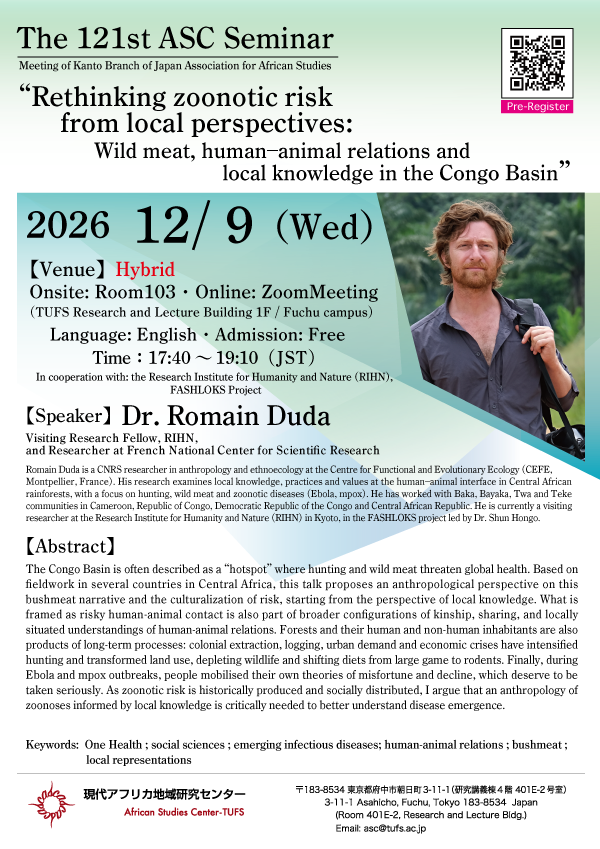
The 121st ASC Seminar will be held on Wednesday, December 9, 2026. Under the title, "Rethinking zoonotic risk from local perspectives: Wild meat, human-animal relations and local knowledge in the Congo Basin" our speaker will share his insights and research.
As the seminar will also be accessible via Zoom, participants are welcome to join remotely from anywhere.
We warmly invite you to attend.
The 121st ASC Seminar
◾️Title:"Rethinking zoonotic risk from local perspectives: Wild meat, human-animal relations and local knowledge in the Congo Basin"
◾️Speaker:
Dr. DUDA, Romain
(Visiting Research Fellow, RIHN, and Researcher at French National Center for Scientific Research)
Bio: Romain Duda is a CNRS researcher in anthropology and ethnoecology at the Centre for Functional and Evolutionary Ecology (CEFE, Montpellier, France). His research examines local knowledge, practices and values at the human-animal interface in Central African rainforests, with a focus on hunting, wild meat and zoonotic diseases (Ebola, mpox). He has worked with Baka, Bayaka, Twa and Teke communities in Cameroon, Republic of Congo, Democratic Republic of the Congo and Central African Republic. He is currently a visiting researcher at the Research Institute for Humanity and Nature (RIHN) in Kyoto, in the FASHLOKS project led by Dr. Shun Hongo.
◆Personal Website(French)→ https://www.cefe.cnrs.fr/fr/recherche/ines/ibc/896-c/4287-romain-duda
◾️Abstract: The Congo Basin is often described as a "hotspot" where hunting and wild meat threaten global health. Based on fieldwork in several countries in Central Africa, this talk proposes an anthropological perspective on this bushmeat narrative and the culturalization of risk, starting from the perspective of local knowledge. What is framed as risky human-animal contact is also part of broader configurations of kinship, sharing, and locally situated understandings of human-animal relations. Forests and their human and non-human inhabitants are also products of long-term processes: colonial extraction, logging, urban demand and economic crises have intensified hunting and transformed land use, depleting wildlife and shifting diets from large game to rodents. Finally, during Ebola and mpox outbreaks, people mobilised their own theories of misfortune and decline, which deserve to be taken seriously. As zoonotic risk is historically produced and socially distributed, I argue that an anthropology of zoonoses informed by local knowledge is critically needed to better understand disease emergence.
◾️Keywords: One Health ; social sciences ; emerging infectious diseases; human-animal relations ; bushmeat ; local representations
◆Date&Time:Wednesday, December 9th, 2026 5:40p.m.~7:10p.m.(JST) 8:40a.m.~10:10a.m.(GMT)
◆Venue:【Hybrid】
・Onsite Room103(1F Research and lecture bldg.,TUFS Fuchu Campus)
・Online(ZoomMeeting)
・Access:https://www.tufs.ac.jp/abouttufs/contactus/access.html
◆Language:English
◆Addmission fee:FREE
Please pre-register in advence from here. Or Use QR Code.
The Zoom link will be sent after you pre-registerd.

Registration deadline: Noon December 9th, 2026 (Wed)
◆Jointly organized by African Studies Center - TUFS and Kanto Branch of Japan Association for African Studies
◆In cooperation with: the Research Institute for Humanity and Nature (RIHN), FASHLOKS Project