

Our staff member, Dr. Kana Miyamoto, presented at the Association of African Studies in Italy (Associazione per gli Studi Africani in Italia: ASAI) Conference held at Pavia University in Italy, and actively engaged with fellow researchers.
Founded in 2010 (and legally established in 2011), ASAI is a nationwide academic association that brings together Africanist scholars across Italy. It is a member of AEGIS (the Africa-Europe Group for Interdisciplinary Studies), a network of African studies centres in Europe, and holds a biennial conference hosted by a different Italian university each time.
Each conference is organized around a theme; this year's was "Africa and Its Waters: Flows, Fates and Frameworks." A total of 33 panels were convened, with interdisciplinary presentations delivered in Italian and English over three days, from July 1 to 3, 2026.
Kana participated in Panel 15, "When Water Becomes Fuel: Sociotechnical Imaginaries and the Reconfiguration of H2O in African Energy Frontiers", where she delivered the following presentation.
◆ Date: 3 July 2026
◆ Venue: Pavia University, Italy
◆ Title: Haunted Harbour: Hydrogen Development and Genocide Memory on Namibia's Southern Coast
◆ Presenter: Dr. Kana Miyamoto (African Studies Center, Tokyo University of Foreign Studies)
◆ Abstract: This paper examines how contemporary green hydrogen development on Namibia's southern coast unfolds within landscapes profoundly shaped by colonial genocide and its afterlives. Focusing on Lüderitz (Kakoverua, ǃNami≠Nüs) and its surrounding port and coastal infrastructures, the paper explores how hydrogen projects promoted as symbols of a green, post-carbon future are layered onto sites historically marked by the incarceration, forced labour, and death of Ovaherero and Nama people during German colonial rule.
Drawing on anthropological fieldwork, archival research, and secondary sources such as documentary films, the paper traces the colonial genealogy of coastal infrastructures, including harbours, railways, and camps, and water systems, examines how these material legacies continue to shape contemporary development planning. While hydrogen imaginaries frame the coast as an "empty" or underutilised space suited for large-scale energy export, local residents, activists, and descendants of genocide survivors articulate these same landscapes as haunted, morally charged, and inseparable from histories of violence and dispossession.
The paper analyses how genocide memory is negotiated, muted, or strategically mobilised in public debates over hydrogen infrastructure, port expansion, and desalination projects. It shows how processes of green industrialisation risk reproducing colonial patterns of erasure by prioritising global climate and export agendas over local histories of suffering and claims for recognition and reparative justice. At the same time, the paper highlights moments in which memory work through commemoration, storytelling, and place-based activism interrupts dominant narratives of green progress.
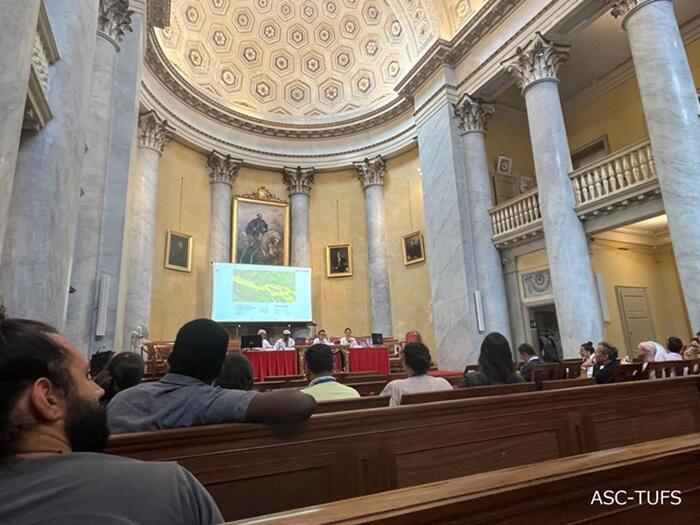
Picture: Opening address at Aula Magna
The panel was organized under the direction of Professor Naoki Naito (Tokushima University) and was made possible through funding from the Grant-in-Aid for Scientific Research (B), "The Anthropology of Energy: A Comparative Study of the Impacts of Renewable Energy Development on Local Communities in Africa".
Professor Marco Gardini (University of Pavia), Secretary General of the ASAI Conference, chaired the session, warmly introduced the President of ASAI and the other panel participants.
In addition, during breaks between the conference sessions, Kana visited the University of Pavia History Museum and the Kosmos Natural History Museum. Curators at both institutions provided detailed explanations of the exhibition of human remains and the issues surrounding the repatriation of cultural objects collected in colonial times in the Italian context. This offered a valuable opportunity to compare these issues with the ongoing debates on restitution in her research theme in Namibia.