

Japanese Language Test Development
Test Development for Measuring Japanese Language Proficiency Growth
Regularly assess progress in Japanese language ability
Understanding how much Japanese language proficiency has increased through learning is important for both learners and instructors. Therefore, our university is developing tests to measure Japanese language proficiency that correspond to the level structure of the education and materials we provide. These tests are developed using the “Academic Japanese Can-do List” as an evaluation metric. The “Academic Japanese Can-do List” is currently undergoing verification for alignment with the Common European Framework of Reference for Languages (CEFR*) levels. In the future, we plan to issue digital certificates (digital badges) to certify Japanese language proficiency levels based on CEFR standards.
Additionally, we are involved in creating questions for various tests that measure Japanese language proficiency.
*CEFR stands for
Common European Framework of Reference for Languages: Learning, teaching, assessment. An international standard for evaluating foreign language proficiency. Originally developed for multilingual contexts in Europe, it is now used worldwide. CEFR represents language proficiency across six levels from A1 to C2.
Designing evaluation indicators
Assessment Framework: Academic Japanese Can-do List
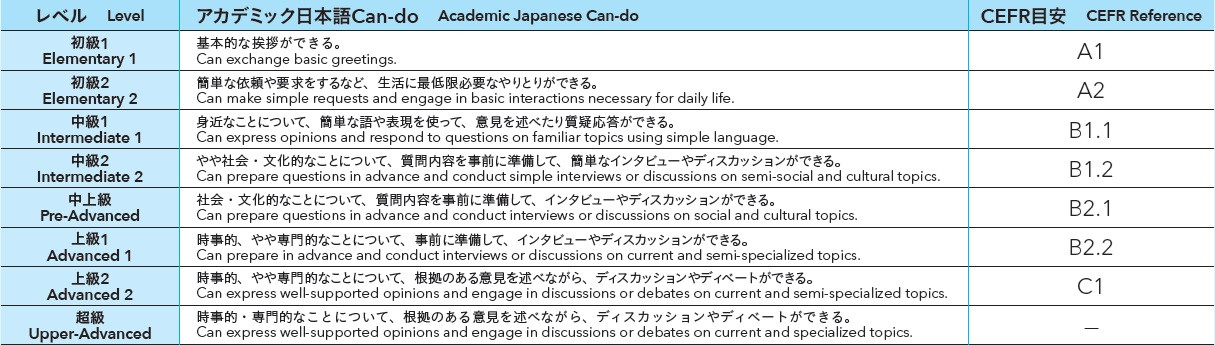
This assessment framework specializes in Academic Japanese. It consists of 4 skills across 5 types (Reading Comprehension, Listening Comprehension, Written Expression, Oral Expression [Monologue], Oral Expression [Dialogue]) × 8 levels (Elementary to Upper-Advanced). The learning objectives, educational content, and assessment criteria for each skill × level are described using “can-do” statements.
Example for Oral Expression [Dialogue]