


Congratulations, New Students! (2026 Entrance Ceremony)
April 4, 2026
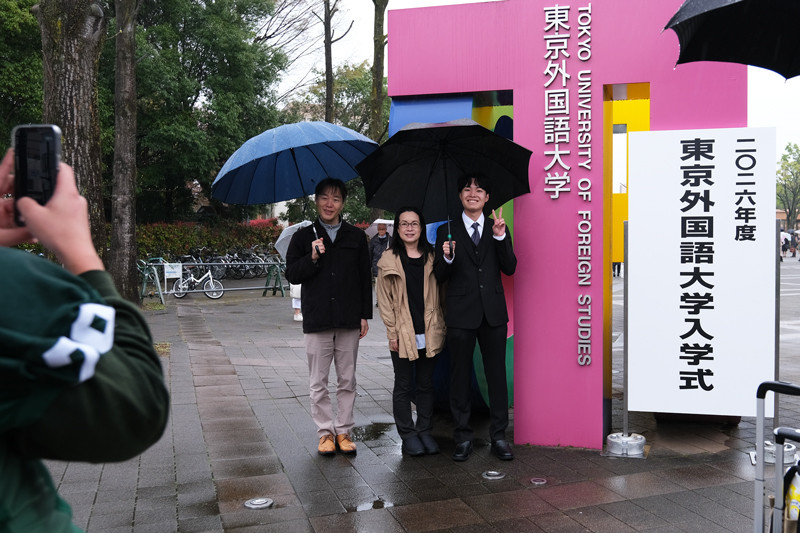
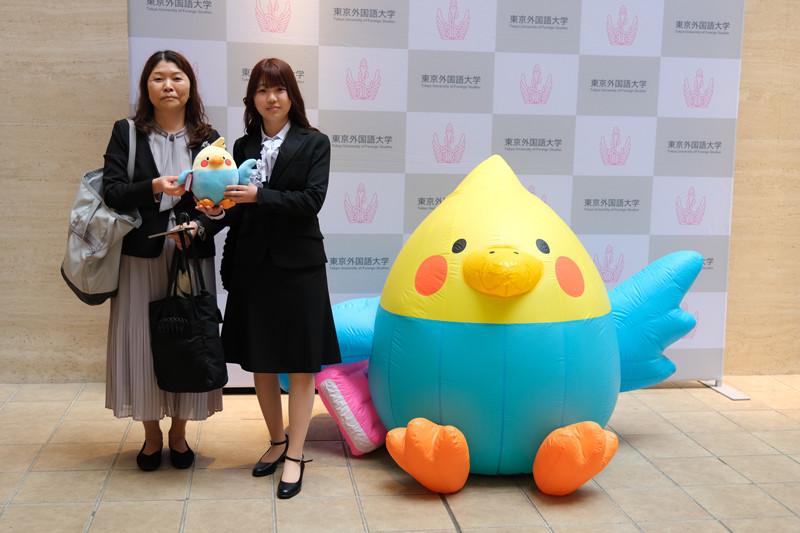
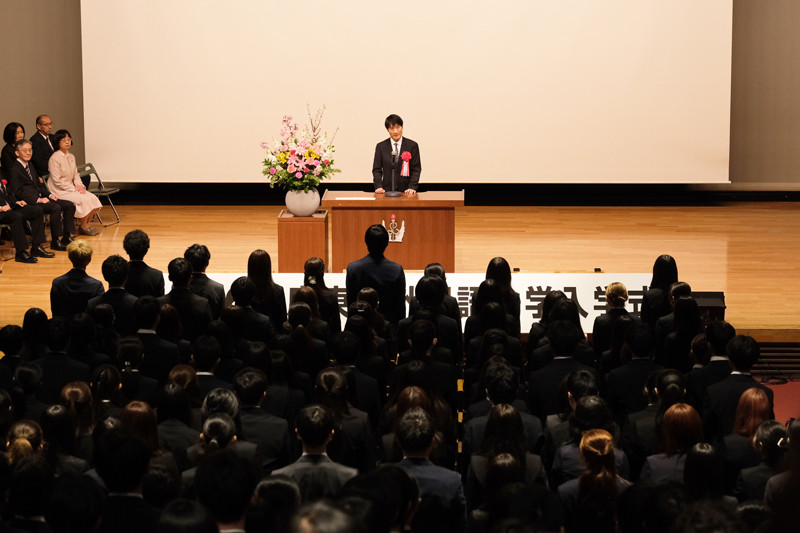
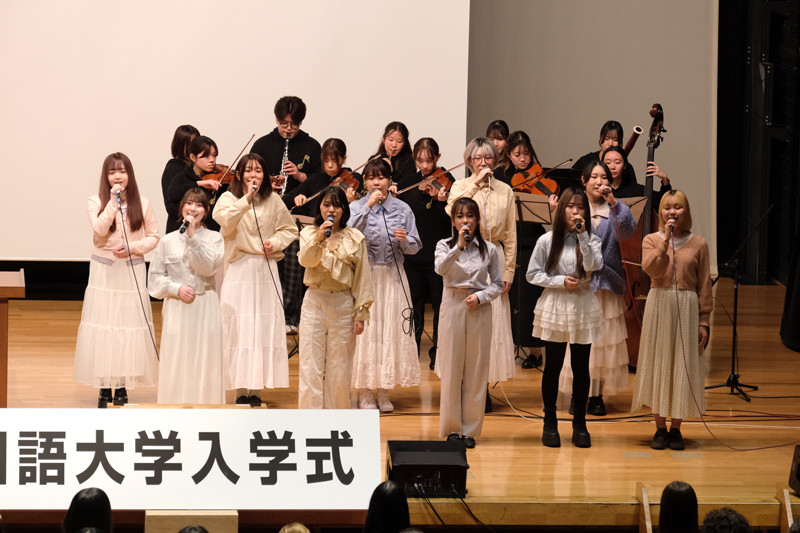
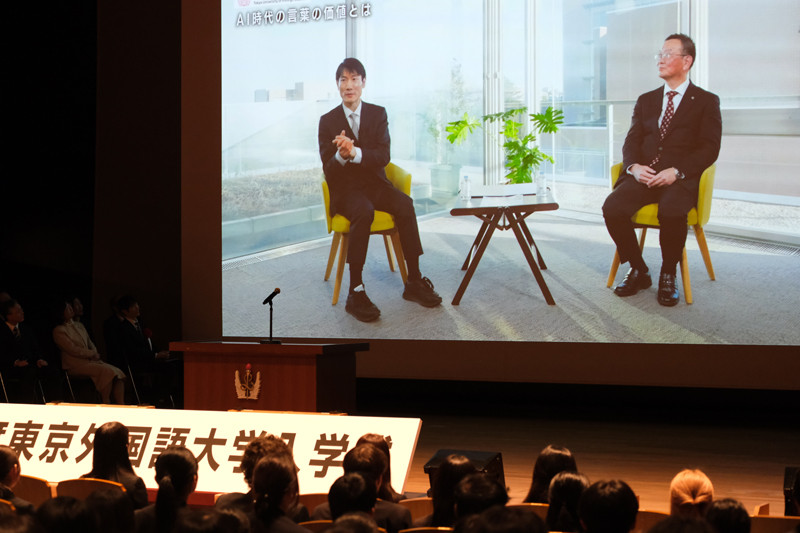
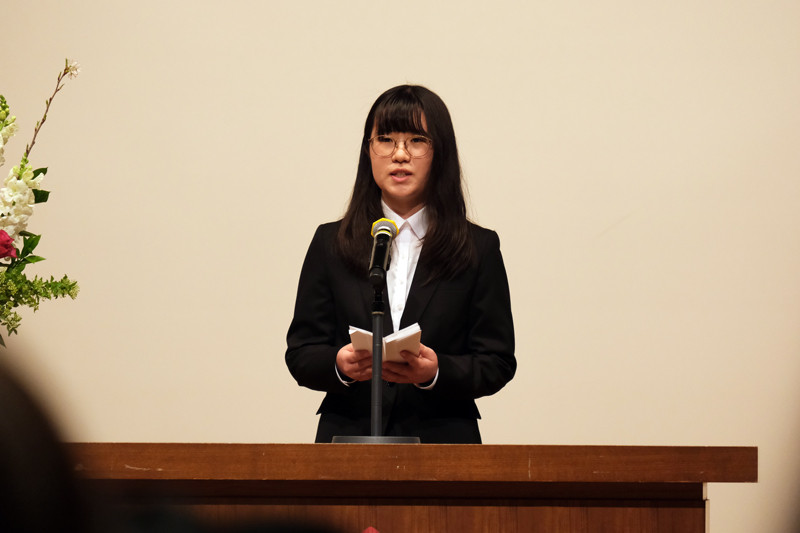
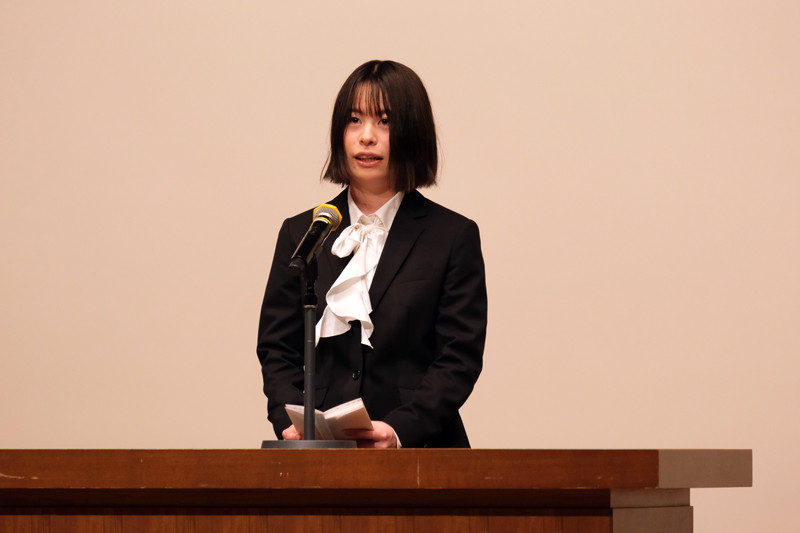
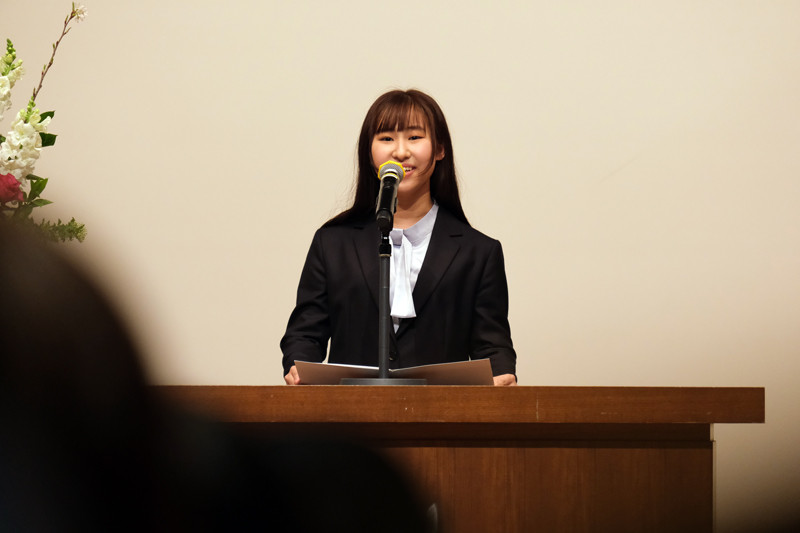
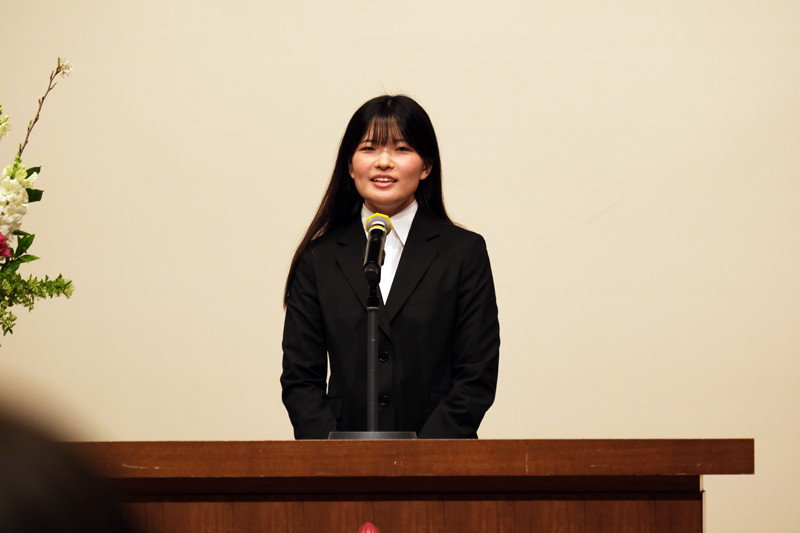
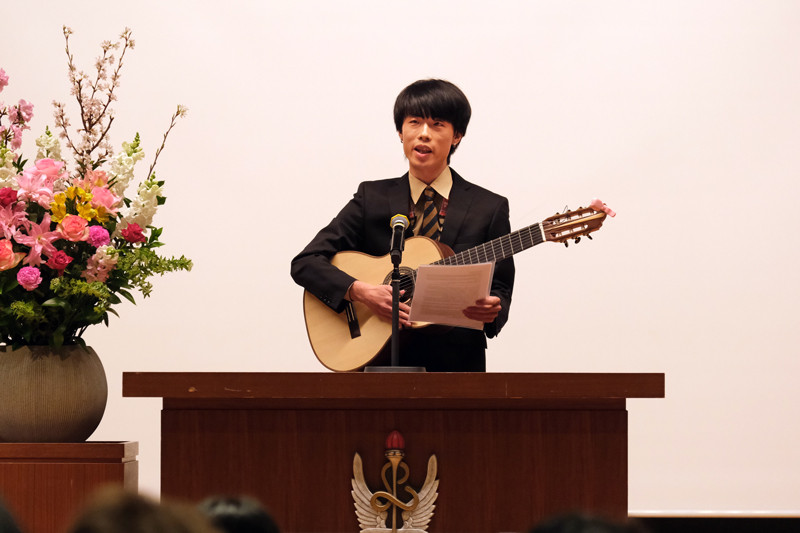
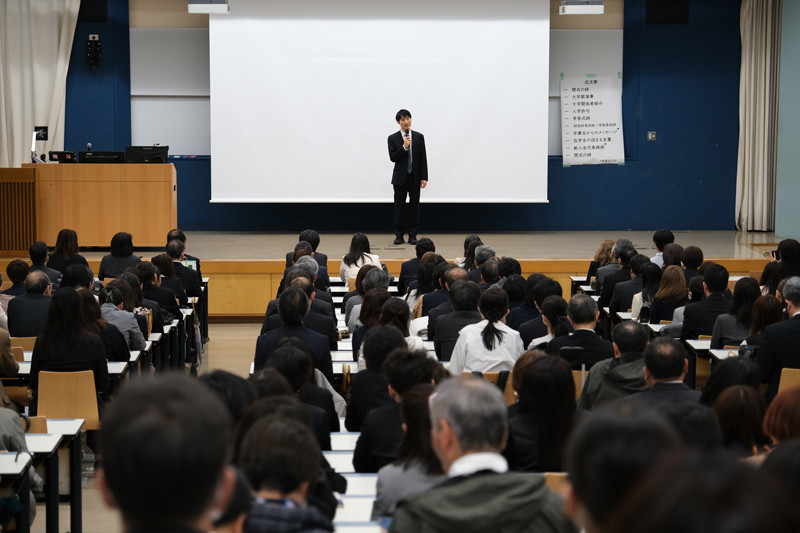
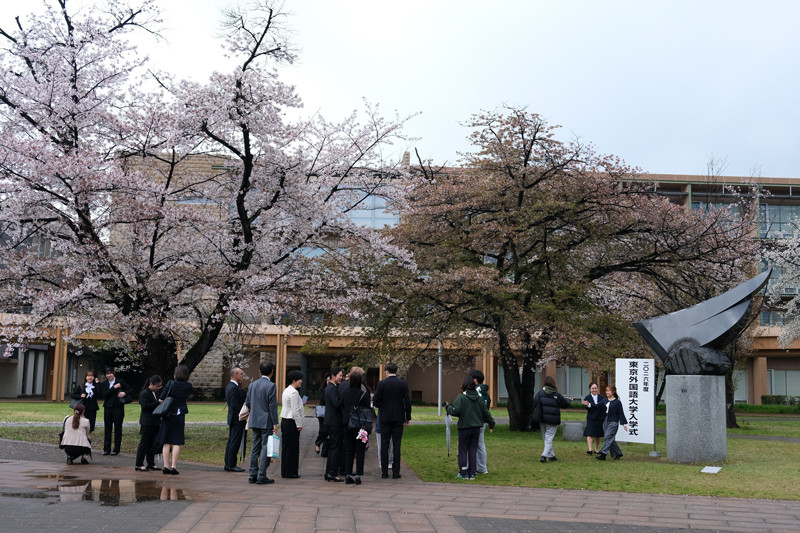
On Saturday the 4th of April, the 2026 Academic Year Entrance Ceremony was held.
TUFS welcomed 356 new students (including 10 transfer students) to the School of Language and Culture Studies, 349 (including 10 transfer students) to the School of International and Area Studies, 87 (including 2 transfer students) to the School of Japan Studies, 141 into the Master’s and Doctoral Programs of the Graduate School of Global Studies – a grand total of 933 new students.
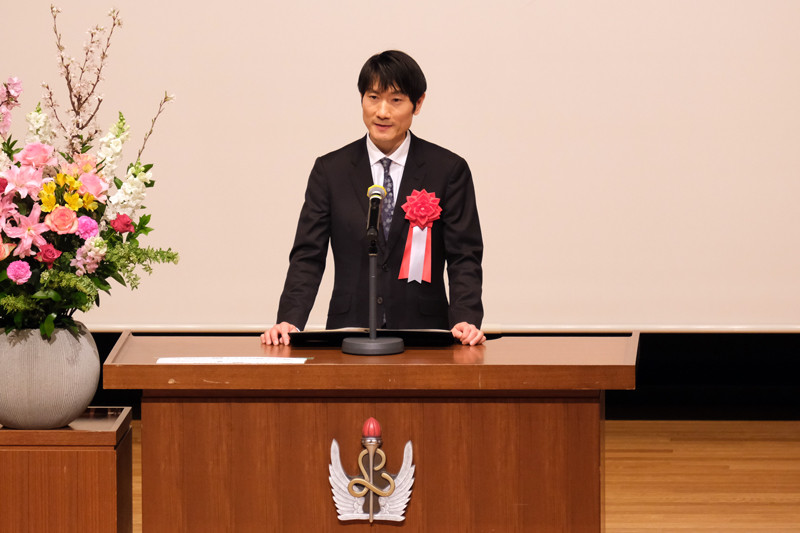
2026 Entry Ceremonial Address from the President (for undergraduate students)
Welcome to Tokyo University of Foreign Studies.
Let me speak in English. I know that most of you will major in a language other than English. And I can tell you that your proficiency in that language will become an advantage throughout your life. But if you lack proficiency in English, that is a disadvantage in the global society. No matter what your major is, all of you should be highly proficient in English.
Let me start with a question. Why did you decide to study at university? And why did you choose this university in particular? I would like you to think over such questions and be aware of your own choice.
Why? Because there are people who question the necessity of learning foreign languages at a time when AI is rapidly developing and spreading.
Why did you choose to enter Tokyo University of Foreign Studies in such an era?
Today, I would like to give you my own answer to this question. I will give you my understanding of why it is meaningful to study foreign languages even in the age of AI.
People meet with each other and talk to each other in person even nowadays when we all make full use of information and communication technology and AI. It seems as if the value of meeting in person has paradoxically increased because of the emergence of a substitutional means, ICT. Either in politics or in business, important negotiations are conducted in person and significant decisions are made in in-person meetings. The Prime Minister of Japan, Takaichi, went to the United States last month, and the President of France, Macron, came to Japan this week.
Companies also prefer business talks and negotiations in person. And companies which have a great deal of overseas transactions value foreign language skills the same as before even in the age of AI. General trading companies such as Toyota Tsusho Corporation or Mitsui and Company have overseas training programs intended to enhance foreign language skills of their employees. According to newspaper Nikkei, the overseas foreign language training programs will remain intact at both companies. A staff member at the human relations department of Mitsui says that foreign language skills enhance competitiveness of trading company employees.
Foreign language skills are significant not only because they are helpful tools in cross-border transactions. Trading companies think that foreign language skills are essential in building confidence with partners overseas.
There is no doubt that jobs and labor practices will change in many workplaces because of the development and spread of AI. According to the Government of Japan, over 4 million clerical workers may become redundant. Even if this forecast proves to be true, I do not think that people will stop meeting each other and talking to each other in person. We will continue to see people physically laughing and nodding in in-person conversation.
The invention of the internet has also changed our ways of working drastically. However, did the wide use of the internet change how we meet each other and talk to each other?
If nothing changes in such situations, the skills we need for successful negotiations will not be different from what we needed in the pre-AI age. Foreign language skills are among those skills.
In his book titled “Foreign Service Training Institute,” Diplomat Kazuyuki Katayama introduced what the Personnel Division at the Ministry of Foreign Affairs has required as essential traits and abilities necessary for diplomats. The head of the Division in 2015 stated as follows:
“Diplomacy is basically the intercourse between states. But examined closely, the relationship between individuals representing states will come to focus. Therefore, each staff member of the Ministry of Foreign Affairs is required to possess many traits and abilities such as flexibility in thinking, negotiation skills, communication skills, high proficiency in foreign languages, and personal charm”
Here again, “high proficiency in foreign languages” is considered as a requirement because the Ministry of Foreign Affairs thinks that it is necessary for their employees to communicate with people overseas, build confidence with people overseas, and be persuasive and influential to people overseas.
In an interview with newspaper Mainichi, Kimiharu Kurokawa, a graduate of TUFS and a former staff of the Ministry of Foreign Affairs with experience as a translator for the Prime Minister, argued that the required English skills in the age of AI are the high-level skills necessary for “moving others, persuading others, and connecting with others in English.”
Linguistic skills necessary for “moving others” should be acquired in your native language first. If you acquire such skills in foreign languages as well, you can expand your horizons into the world outside Japan. To quote Mr. Kurokawa’s expression, English is “a potential amplifier of life.”
If the value of talking to others in person, and especially talking to others in person across borders, does not fade away, the value of studying foreign languages and acquiring high proficiency in foreign languages will not diminish even after AI spreads widely across the world.
Let me talk about another reason why it is meaningful to study foreign languages.
Language acquisition does not end with memorizing words. Words do not match one-to-one with what they indicate. A word is not a “dot,” but rather an “area.” The perimeter is determined by its relations with other words. Even the connotation of a noun has range. What a verb means is furthermore ambiguous.
Mutsumi Imai and Kimi Akita, in their award-winning best-seller “Essence of Language,” explained that children learn words through trial and error. Children try words in contexts they think suitable. In some cases, they are correct, but in many other cases they are not. We all learned our native language through such a process of trial and error.
Doesn’t this process of language acquisition resemble research, the creative act of acquiring new knowledge? In language acquisition, we build our own “hypotheses” concerning the meaning and usage of words, we test them through trial and error. We consolidate our understanding when we are correct and make corrections when we are wrong. Isn’t this the same procedure as academic research? I might be overstating, but we learn languages by accumulating tiny “discoveries.”
Your process of learning a foreign language will not be the same as children learning their native language. You already have experience of learning your native language and you also have wisdom that children lack. However, you will also go through the trial-and-error process of hypothesis-building, testing, correcting, and consolidating just as children do. Therefore, by studying foreign languages, you will train yourself in intellectual creation without noticing.
I talked too much. Let’s wrap up. Some people say that it is inefficient to put much time and effort into learning foreign languages now that we have high-end AI spreading around the world. But I believe that the value of linguistic skills will not diminish because we need them to build confidence with others and move others when we meet and talk to others in person. I believe that the importance of in-person meetings will increase because of the development and spread of ICT and AI.
Enhancing your skills of communication is not the only advantage of learning foreign languages. The trial-and-error process of thinking, trying, failing, and learning which you go through is nothing but the training for intellectual creativity.
Fearless challenges and trial and error are necessary in the process of learning foreign languages. You will make error after error in the process. The same repetition of challenges and errors accompany any process of creating something new. As Thomas Edison mentioned, there is no success without failures.
Welcome to university. Welcome to Tokyo University of Foreign Studies. Starting today, I would like you to take on new challenges without any fear. We will always be by your side.
-
Nobuo HARUNA
President, Tokyo University of Foreign Studies
April 4, 2026
2026 Entry Ceremonial Address from the President (for graduate students)
Welcome to Tokyo University of Foreign Studies.
Ideals and principles tend to be the topics of entrance ceremony speeches, but today I would like to present a message to you that dares you to face reality.
What is the purpose of your enrollment in this program?
Many of you, especially those who are entering doctoral programs, may aspire to become university professors. I sincerely hope that those aspirations will be fulfilled.
However, please do not narrow down your future career to a single path just yet.
I must admit that even today only a small number of graduates of the postgraduate programs at TUFS are employed as university faculty members or in other stable research or educational positions. In the future, if the number and capacity of universities decrease due to the declining birthrate and the significant decrease in the young population, university faculty position openings will become even “narrower” than they are already.
In fact, many graduates of master’s degree programs go on to be employed by companies and other organizations outside of research and educational institutions. In Japan, such organizations often do not require a master’s degree for employment nowadays. However, international and highly specialized professions require a master’s degree even today.
Last year I had a talk with staff members from the International Monetary Fund, IMF. They were looking for students willing to work at the Corporate Services and Facilities Department at the IMF. A master’s degree is required. They also introduced an internship program at the department exclusively for postgraduate students. In general, a master’s degree is required to work at international organizations. A master’s degree is even required for public service positions in some countries.
At the entrance ceremony last year, I mentioned a graduate of TUFS who was working for an NGO providing humanitarian assistance in Palestine. He was taking an online master’s degree program at the School of Oriental and African Studies, University of London at the same time. He needed a master’s degree to build his career in the humanitarian aid field.
The number of doctoral graduates who go on to work in organizations other than research and education institutions, such as corporations, is still very small. However, I believe that it is desirable for our university and Japanese society to increase the number of people who obtain doctoral degrees and find employment in fields other than research and education. As the population continues to decline, the wisdom and creativity of each individual and their contribution to society will become more important than ever before. This is because we need to tackle unprecedented issues, such as the transition to a sustainable society, with fewer people than today. Japanese society of the future will benefit from people who have spent longer periods of time receiving education and being trained intellectually.
Looking abroad, PhD holders are active in wider fields than they are in Japan. In Japan, the number of PhD holders per million people is only 120, while in Germany, the United Kingdom, and South Korea, the number exceeds 300. In the United States, the number is also approaching 300. In those countries, the number of university faculty members per population is not significantly higher than in Japan. Many of them have doctoral degrees but are active in a variety of organizations other than universities or other research and educational institutions.
Therefore, even if your first choice is to become a university professor, I suggest that you consider other options as well. In other words, always think of how you can make use of what you learn through research activities in graduate school.
I believe that the skills you acquire through research activities will serve you well in occupations other than inside academia. Research is most definitely a creative activity. You choose your own topic, set your own question, and search for an answer to the question by yourself. You probably need to choose, collect, and analyze the necessary materials. In some cases, you need to obtain original data through interviews or questionnaire surveys. The entire process is full of chances to develop creativity.
Creativity is what we need in the age of change. We need new ideas to tackle unprecedented challenges. We must cope with the coming labor shortages, and we must transform our society into a sustainable one.
The skills you develop through the individual steps of academic research are also transferable to other activities. You go through the steps of identifying problems, planning, collecting materials, analyzing, and logical thinking. It is not difficult to find a job in which you can make use of the skills you develop through each of these steps.
It has been widely believed in Japanese society that those who enter graduate schools in humanities, especially those entering doctoral programs, naturally aspire to careers in academia. In the future, this view is likely to change. You are at the turning point and therefore you are pioneers. You will have to cultivate your own path that is different from the paths followed by your predecessors.
Tokyo University of Foreign Studies is committed to supporting you as much as possible in opening diverse career paths. Last year a class called “Transferable Skills Practicum” started in the doctoral program. This year we will commence an extra-curricular program in collaboration with Kikkoman Corporation, the world’s leading manufacturer of soy sauce. Students who conduct research about the relationship between taste and language or other similar topics may receive funding from Kikkoman.
Even though TUFS is embarking on new projects, the university is still in a state of exploration. There may be many aspects that the university has yet to perfect. If you have any requests, please let me or the faculty know. I believe people who have received longer education and intellectual training should be active in a variety of fields and contribute to society in a variety of ways. Let us work together to create such a society.
The road ahead of you may not be smooth. Therefore, I think that the word “congratulations” should be saved for later.
Instead, I will say, welcome to Tokyo University of Foreign Studies. Your journey begins here. We will always be by your side.
-
Nobuo HARUNA
President, Tokyo University of Foreign Studies
April 4, 2026